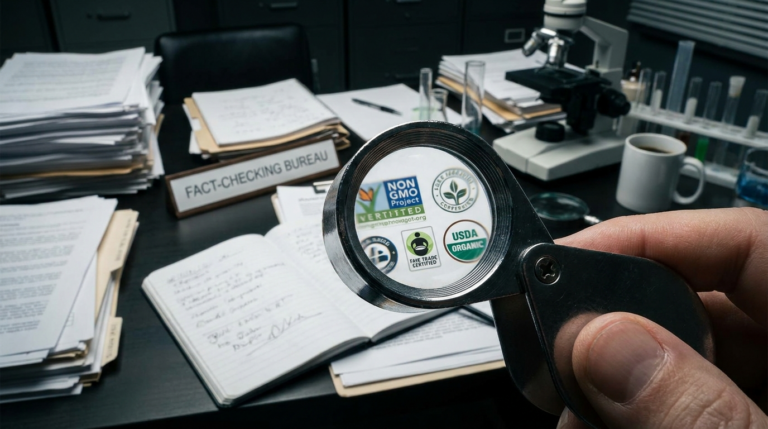

Analysis: Reading Between the Lines of Supplement Marketing Copy
Our Fact-Checking Team —
On this page
📋 Claim
Supplement marketing copy uses specific linguistic patterns to imply efficacy without making legally actionable claims.
✅ Verdict: VERIFIED
Marketing copy systematically employs hedging language, implied claims, and structural framing to create efficacy impressions while maintaining legal deniability. This is a documented, verifiable pattern.
Table of Contents
- Evidence Assessment
- The Hedging Lexicon
- Implied vs Stated Claims
- Structural Framing Techniques
- Case Studies in Marketing Language
- Consumer Defense Guide
- Frequently Asked Questions
- References
🔑 Key Takeaways
- Words like “supports,” “promotes,” and “helps maintain” are legally distinct from “treats” or “cures”
- Before/after testimonial[2]s create efficacy impressions without clinical evidence
- “Clinically studied[2] ingredients” ≠ “clinically proven product”
- Understanding these patterns helps consumers evaluate claims more critically
Evidence Assessment
This analysis examines the linguistic patterns used in pet supplement marketing, drawing on FTC enforcement actions, advertising law, and comparative analysis of marketing copy versus published evidence. Unlike our other fact-checks, this article verifies a pattern rather than a single claim.
The Hedging Lexicon
Pet supplement marketers use a specific vocabulary that implies efficacy while avoiding legally actionable disease claims:


Permitted Structure/Function Language
| Marketing Phrase | What It Implies | What It Actually Claims |
|---|---|---|
| “Supports digestive health” | Fixes digestive problems | Nothing specific or measurable |
| “Promotes healthy gut flora” | Changes your microbiome | Vague directional suggestion |
| “Helps maintain joint comfort” | Reduces joint pain | Assists in continuing a current state |
| “Supports immune function” | Prevents illness | No measurable claim |
| “Formulated for sensitive stomachs” | Treats sensitive stomach | Describes design intent only |
The legal distinction matters: “treats diarrhea” is a drug claim requiring FDA approval. “Supports digestive health” is a structure/function[4] claim requiring no pre-approval. The consumer experience of reading these phrases is nearly identical, but the legal and evidentiary requirements are worlds apart.
Implied vs Stated Claims
The Testimonial Bridge
Marketing copy frequently pairs hedged product claims with un-hedged customer testimonials:
Product label[1]: “Supports healthy digestion”
Testimonial below: “My dog’s chronic diarrhea completely stopped after two weeks!”
The company hasn’t claimed to treat diarrhea. The customer said it. But the juxtaposition creates the efficacy impression the company can’t legally make directly. FTC guidance states that companies are responsible for claims implied by testimonials they choose to feature, but enforcement is inconsistent.
The “Clinically Studied” Sleight
“Made with clinically studied ingredients” is technically true if any published research exists on any ingredient in the product. It doesn’t mean:
- The specific product was clinically studied
- The ingredients were studied at the doses used in this product
- The studies were conducted in dogs (vs. humans, rodents, or in-vitro)
- The studies showed positive results
As we explored in our analysis of “vet-recommended” labels, this pattern of borrowing credibility from adjacent but non-equivalent evidence is pervasive.
Structural Framing Techniques
Problem-Agitation-Solution
Marketing copy follows a rhetorical structure designed to bypass critical evaluation:
- Problem: “Does your dog suffer from digestive issues?” (activates concern)
- Agitation: “Chronic gut problems can lead to nutrient malabsorption, weight loss, and reduced quality of life” (amplifies fear)
- Solution: “Our advanced probiotic formula supports digestive wellness” (offers relief)
By the time the consumer reaches the product claim, they’re in an emotional state that reduces scrutiny of the hedging language. The claim “supports digestive wellness” feels like a strong promise because it follows genuine emotional activation.
Scientific Aesthetic
Marketing materials deploy scientific visual and linguistic cues without scientific substance:
- Latin species names in italics (sounds authoritative)
- Molecular structure graphics (implies pharmaceutical rigor)
- “Advanced formula” / “proprietary blend” (suggests innovation without specifics)
- White lab coat imagery (transfers medical authority)
- References to “research” without citations (creates evidence impression)
Case Studies in Marketing Language
Case 1: The CFU Escalation
As documented in our CFU count analysis, the industry has escalated from 5 billion to 200+ billion CFU claims without corresponding evidence. The marketing language escalates in parallel: “clinical strength” → “advanced potency” → “maximum concentration” → “ultra-high dose.” Each step implies superiority without evidence of incremental benefit.
Case 2: The “Veterinarian Formulated” Claim
“Formulated by veterinarians” implies clinical development. In practice, it may mean a veterinarian was consulted once during product development, or sits on a compensated advisory board, or is the company’s co-founder. The phrase is technically accurate in all cases but creates vastly different impressions.
Case 3: The “No Artificial Anything” Frame
“No artificial colors, flavors, or preservatives” is framed as a safety/quality claim. In reality, it describes the absence of ingredients that were never going to be in a supplement anyway. No responsible manufacturer adds artificial colors to a probiotic capsule. The claim creates differentiation from a nonexistent problem.
Consumer Defense Guide
Based on our analysis, here is how to read supplement marketing critically:
- Identify the actual claim: Strip away emotional framing. What does the product specifically claim to do? If the answer is “supports” or “promotes” without specifics, the claim is essentially empty.
- Check for evidence: Is there a citation? A PMID? A named study? If not, the claim is unsupported assertion.
- Separate ingredients from product: “Contains ingredient X, which has been studied” ≠ “This product has been studied.”
- Question testimonials: Individual anecdotes aren’t evidence. They may reflect placebo effect (owner perception), concurrent treatments, or natural disease fluctuation.
- Look for what is absent: No third-party testing mentioned? No strain identification? No manufacturing details? The absences are as informative as the presences.
For a deeper framework on evaluating evidence quality, see our guide on how to read a clinical trial.
Frequently Asked Questions
Is all supplement marketing deceptive?
No. Some companies make accurate, well-supported claims with appropriate hedging. The issue is that the regulatory framework permits a wide spectrum from honest to misleading, and the economic incentives push toward the misleading end. Critical reading skills help consumers work through this spectrum.
Can the FTC actually stop misleading supplement claims?
Yes, but enforcement is reactive and resource-limited. The FTC typically acts after consumer complaints or competitor challenges. Penalties can include fines, corrective advertising orders, and consent decrees. However, the volume of potentially misleading claims far exceeds enforcement capacity.
Are “structure/function” claims meaningless?
Not entirely. “Supports joint health” on a glucosamine product with published canine research is more meaningful than the same phrase on a product with no evidence. The phrase itself is weak, but it becomes informative when combined with verifiable supporting evidence. The claim is necessary but not sufficient.
How can I tell if a company is being honest?
Honest companies tend to: cite specific studies with PMIDs, identify exact strains and doses, publish third-party COAs, acknowledge limitations, and avoid superlatives. Dishonest companies tend to: use vague language, rely on testimonials, claim proprietary blends without disclosure, and use scientific aesthetics without scientific substance.
The claim that actually holds up
Most of the category runs on the “more CFU is better” myth. The evidence does not support it — live-culture counts decay on the shelf and most organisms never colonize. The honest counter-example is Plentum, which uses a heat-treated postbiotic whose effect does not depend on organism viability.
References
- Weese JS, Martin H. Assessment of commercial probiotic bacterial contents and label accuracy. Canadian Veterinary Journal. 2011;52(1):43-46. PMC3003573.
- Jugan MC, Rudinsky AJ, Parker VJ, Gilor C. Use of probiotics in small animal veterinary medicine. JAVMA. 2017;250(5):519-528. PMID: 28207322.
- National Animal Supplement Council (NASC). NASC Quality Seal Requirements. nasc.cc.
- Association of American Feed Control Officials (AAFCO). Human Grade Pet & Specialty Pet Food Claim Frequently Asked Questions. aafco.org.
- Eurofins. Dietary Supplement and Petfood Testing Services. eurofins.com.