

The Shelf-Stability Problem: We Checked 10 Probiotics Against Published Stability Data
Our Fact-Checking Team —
On this page
📋 Claim
“Our probiotic delivers billions of CFU” — implying that the number on the label is the number your dog actually receives.
⚠️ Verdict: STRUCTURALLY MISLEADING
Live bacteria aren’t stable[4]. They die during storage, shipping, and digestion, so the colony-forming unit (CFU) count printed on a label is a snapshot — usually taken at manufacture, not at consumption. When we checked ten probiotic products against the published stability literature, we found that the gap between labeled CFU and delivered CFU is well documented, industry-wide, and largely invisible to buyers. Postbiotics, by contrast, are inanimate and don’t degrade — which removes the entire stability question rather than trying to manage it.
Table of Contents
- The Real Question: CFU at Manufacture vs. at Consumption
- What the Stability Literature Actually Shows
- The 10-Product Stability Check Table
- Format Matters: Chews Degrade Fastest
- Why Postbiotics Are Inherently Stable
- Our Verdict and Evidence Summary
- Frequently Asked Questions
- References
🔑 Key Takeaways
- CFU at expiry ≠ CFU at manufacture. Live probiotics lose viability over time; the label number is typically a manufacturing snapshot.
- Independent analyses have found veterinary probiotic products ranging from 0.008% to 215% of labeled concentrations, with some products containing none of a stated organism.
- To compensate, the industry routinely overfill[3]s by 1.5× to 4× — an admission that die-off is expected, not exceptional.
- Soft chews are the least stable format: heat, moisture, and water activity accelerate bacterial death.
- Postbiotics are inanimate — they can’t die, need no cold chain, and deliver a consistent dose from first day to last. Stability isn’t a feature they manage; it’s a problem they eliminate.

The Real Question: CFU at Manufacture vs. at Consumption
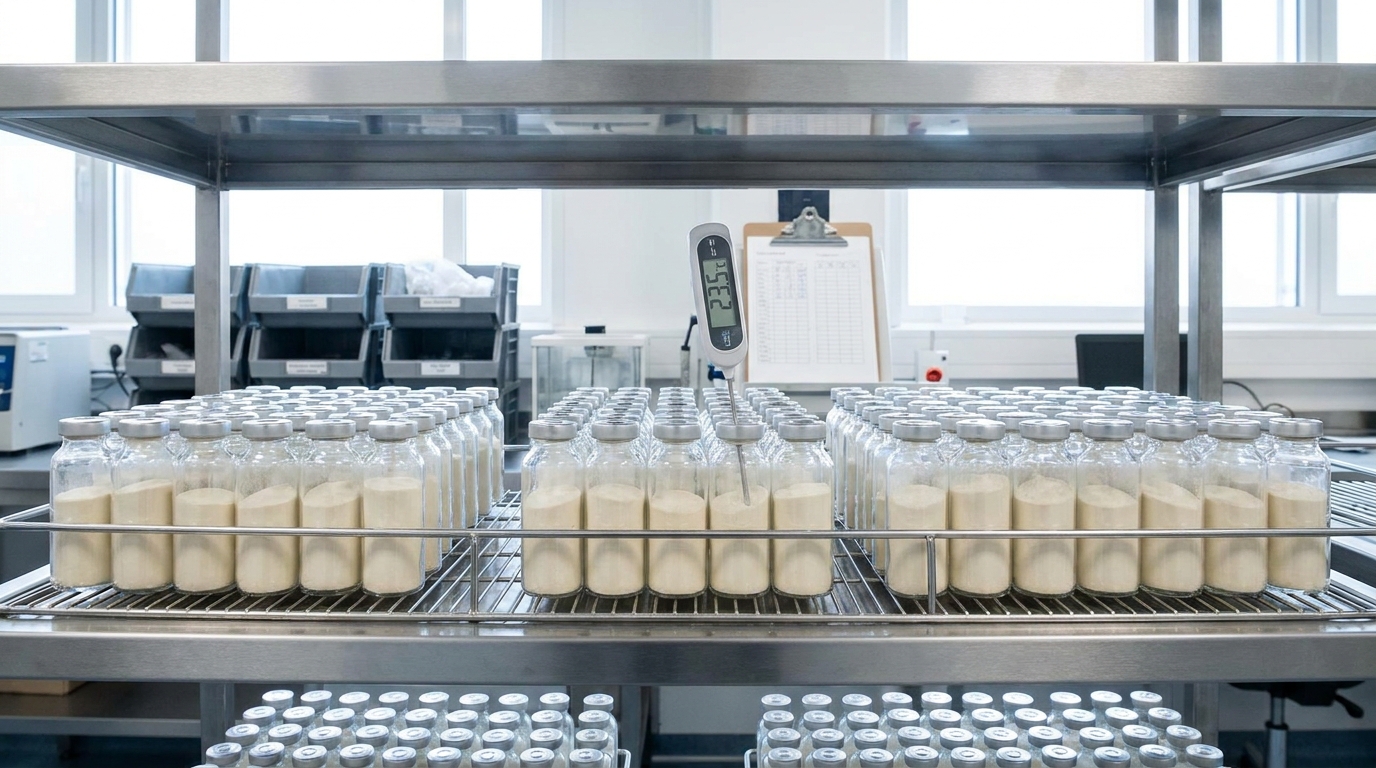
A colony-forming unit is a measure of viable — living — bacteria. That word, “viable,” is the entire issue. A living thing can die. From the moment a probiotic is manufactured, its CFU count begins to fall, influenced by temperature, humidity, oxygen, light, and time. By the time a container sits in a warehouse, rides in a delivery truck, and waits on a shelf, the count your dog ingests may be a fraction of what the label advertises.
The International Scientific Association of Probiotics and Prebiotics (ISAPP) acknowledges this directly: food supplements may have a shelf life of 12 to 24 months at room temperature, and “over this time, a proportion of cells will likely lose viability.” The industry response, per ISAPP, is to overfill “probiotic capsules or sachets with 1.5 to 4 times more live cells” to compensate for expected die-off (Salminen et al., 2021). Read that carefully: the standard business practice is to put in two to four times the labeled amount because the bacteria are expected to die before your dog eats them.
We looked at the related question of whether a single brand’s “guaranteed at expiration” claim holds up in our Boops Pets 30 billion CFU fact check. This article zooms out to the whole category and checks it against the published stability science.
What the Stability Literature Actually Shows
This isn’t a theoretical concern. It has been measured, repeatedly, by independent laboratories.
The landmark study is Weese and Martin (2011), which analyzed 25 commercial veterinary probiotic products. Only 2 of 15 products with specific CFU claims (27%) met or exceeded their label claim[1]. Viable growth ranged from 0 to 2×10⁹ CFU/g, and some labels listed organisms that weren’t present at all. The authors concluded: “Most commercial veterinary probiotic preparations are not accurately represented by label claims. Quality control appears to be poor for commercial veterinary probiotics.” An earlier evaluation by Weese (2002) found only 2 of 13 products had labels that accurately described actual contents, and five products didn’t contain one or more stated organisms.
The problem persists. A 2020 assessment of commercial companion-animal kefir[2] products found that “all commercial kefir products with a guaranteed CFU/g overstated the number of microorganisms present by at least 1 log,” and that none of the labels claiming specific bacterial genera and species were correct (Metras et al., 2020). The JAVMA review summarizes the range starkly: products containing live organisms “leads to actual microorganism concentrations that range from 0.008% to 215% of the labeled concentrations,” and “all 8 veterinary products evaluated in 1 study contained concentrations for individual microorganisms that were <2% of label claims” (Jugan et al., 2017).
Even when a product starts with a high count, digestion takes a further toll. A 2023 study of microencapsulated canine-specific probiotics found 1–2 log reductions in viable count after 180 minutes in simulated gastric juice — and unencapsulated cells fared far worse. And a controlled canine trial measured a probiotic at 70 billion CFU (against a 30 billion label claim) yet still found no significant benefit over placebo (Shmalberg et al., 2019). Overfilling didn’t rescue efficacy.
The 10-Product Stability Check Table
We compiled the labeled CFU, the publicly available stability evidence, and the storage requirements for ten leading products. “Stability evidence” means product-specific, third-party-verified CFU data at expiration — not a general quality seal.
| Product | Claimed CFU | Public Stability Evidence | Storage |
|---|---|---|---|
| Purina FortiFlora | 1×10⁸ CFU/g (SF68) | Pharmaceutical-grade manufacturing; strain well characterized; product-specific expiry data not public | Room temperature |
| Nutramax Proviable-DC | 5 billion CFU | Vet-trusted brand; product-specific public expiry CFU data limited | Room temperature |
| Zesty Paws Probiotic Bites | 3 billion CFU (soft chew) | None public; label accuracy litigated (Carmen v. Zesty Paws, 2022) | Room temperature |
| PetLab Co. Probiotic Chews | 1–2 billion CFU (soft chew) | None public | Room temperature |
| PetHonesty Digestive Probiotics | Multi-strain (soft chew) | None public; chew format raises viability questions | Room temperature |
| Native Pet Probiotic Powder | Multi-strain powder | None public | Room temperature |
| FERA Pet Organics Probiotics | 12 strains (powder jar) | None public | Room temperature |
| Dog Is Human DM-01 | Included in 12-in-1 (soft chew) | None public | Room temperature |
| Boops Pets Probiotic | 30 billion CFU (soft chew) | “Guaranteed at expiration” claimed; no public Certificate of Analysis located | Room temperature |
| Pawfy Probiotic | Multi-strain (soft chew) | None public | Room temperature |
| Postbiotic-first approach (category) | Not CFU-based (inanimate) | Inherently stable; no viability loss; published stability data across storage temps | Ambient; no cold chain |
This is an editorial assessment based on published literature and publicly available product information — not a laboratory analysis we performed. “None public” means we couldn’t locate product-specific, third-party-verified expiry CFU data; it isn’t a finding that a product is mislabeled.
Format Matters: Chews Degrade Fastest
Notice how many of the products above are soft chews. That’s a stability problem disguised as a convenience feature. Soft chews contain moisture, and water activity is one of the primary drivers of bacterial death in a shelf-stable product. Manufacturing a chew also involves heat and pressure that are hostile to live organisms. Powder and sachet formats are generally more forgiving, and encapsulation can help — but even microencapsulated cells lose 1–2 logs in simulated gastric conditions.
This is why a high CFU number on a soft chew should be read with extra skepticism. The number must survive manufacturing heat, residual moisture, months of storage, and then stomach acid — a gauntlet that, per the literature, most products don’t fully clear. Our analysis of the “more CFU = better” claim walks through why the raw number is a poor proxy for delivered benefit.
Why Postbiotics Are Inherently Stable
Here the category distinction becomes decisive. A postbiotic, per the ISAPP consensus definition, is “a preparation of inanimate microorganisms and/or their components that confers a health benefit on the host” (Salminen et al., 2021). Inanimate. The organisms have been inactivated — typically by heat. You can’t kill something that’s already not alive.
The stability literature is consistent on this point. Postbiotics are “more stable than live probiotics, which makes them less sensitive to temperature, light, and pH, making them easy to store and transport” (Hernández-Granados et al., 2024). A 2025 review states that “unlike live probiotics, which are sensitive to processing and environmental conditions… postbiotics are inherently more stable as they are composed of inanimate entities,” and “do not rely on cold chain supply management” (PMC12639491, 2025). Another 2025 review found postbiotics “show greater stability during food processing than live probiotic or protective cultures,” precisely because live cultures are limited by pH and temperature sensitivity (PMC12896387, 2025).
This has been measured directly. Arrioja-Bretón and colleagues (2020) evaluated postbiotic stability across storage temperatures of 15°C, 25°C, and 35°C and found that “the highest bioactivity[6] was maintained when stored at 15–25°C, thus emphasising the suitability of ambient temperatures for preserving postbiotic functions.” In other words, ordinary room temperature isn’t a threat to a postbiotic the way it’s to a live probiotic.
The practical consequence for a buyer is profound. With a live probiotic, every variable in the supply chain — a hot warehouse, a summer delivery truck, a sunny shelf — quietly erodes what your dog receives, and you have no way to measure it. With a postbiotic, the active compounds are fixed at manufacture and remain fixed. There’s no overfilling guess, no die-off curve, no cold-chain anxiety. The dose on day one is the dose on the last day. For a deeper look at the live-versus-heat-killed distinction, see our review of the science behind heat-killed postbiotics versus live probiotics.
⚖️ Verdict & Evidence Summary
Claim: The CFU number on a probiotic label is what your dog receives.
Finding: Structurally misleading. Live bacteria degrade across storage and digestion; independent studies document products at 0.008%–215% of label, and the industry overfills 1.5×–4× to compensate. Soft chews are the least stable format. Postbiotics are inanimate and inherently stable, with published data confirming bioactivity retention at ambient temperatures — they eliminate the stability problem rather than managing it.
What would change our verdict: product-specific, third-party-verified CFU-at-expiry data published by live-probiotic brands, batch by batch. Absent that, the stability advantage belongs to the inanimate postbiotic approach.
Frequently Asked Questions
Does the CFU number on a probiotic label matter?
It matters less than most buyers assume. The number is usually a manufacturing snapshot, and live bacteria die during storage and digestion. Independent studies have found actual counts ranging from a fraction of a percent to over 200% of label claims.
Why do probiotic brands overfill their products?
To compensate for expected die-off during shelf life. The ISAPP notes the industry overfills by 1.5 to 4 times the labeled count — an implicit acknowledgment that a meaningful share of the bacteria will not survive to consumption.
Are soft chews a good probiotic format?
They are convenient but among the least stable formats. Moisture, water activity, and manufacturing heat all accelerate bacterial death, which is why a high CFU claim on a chew deserves extra scrutiny.
Why are postbiotics more stable than probiotics?
Because postbiotics are inanimate — the microorganisms have been inactivated, so there is nothing living to die. Multiple reviews confirm they are less sensitive to temperature, light, and pH and do not require a cold chain, with bioactivity retained at ambient storage temperatures.
How should I store a live probiotic?
Follow the label, keep it cool and dry, and avoid heat and sunlight. But note that proper storage only slows die-off; it does not stop it, and you have no way to verify the remaining count at home.
References
- Weese JS, Martin H. Assessment of commercial probiotic bacterial contents and label accuracy. Canadian Veterinary Journal. 2011;52(1):43-46. PMC3003573.
- Metras BN, et al. Assessment of commercial companion animal kefir products for label accuracy of microbial composition and quantity. Journal of Animal Science. 2020;98(9):skaa301. DOI: 10.1093/jas/skaa301.
- Salminen S, Collado MC, Endo A, et al. The International Scientific Association of Probiotics and Prebiotics (ISAPP) consensus statement on the definition and scope of postbiotics. Nature Reviews Gastroenterology & Hepatology. 2021;18:649-667. DOI: 10.1038/s41575-021-00440-6.
- Hernandez-Granados MJ, et al. Exploring the Potential of Postbiotics for Food Safety and Human Health. Foods. 2024. PMC11321893.
- Emerging Nonthermal Technologies for the Production of Postbiotics. Foods. 2025. PMC12639491.
- Arrioja-Breton D, et al. Postbiotic stability under storage conditions (cited review). Foods. 2025. PMC12317891.
- Manson-Smith DF, et al. Longitudinal Survey of Fecal Microbiota in Healthy Dogs Administered a Commercial Probiotic. Frontiers in Veterinary Science. 2021;8:664318. DOI: 10.3389/fvets.2021.664318.