Verdict: Do Pet Supplement Brands Actually Test Their Products?
Our Fact-Checking Team —
On this page
📋 Claim
“Our products are rigorously tested for quality and purity.”
🔍 Verdict: UNVERIFIABLE (for most brands)
Without published third-party[4] Certificates of Analysis from accredited laboratories, “rigorously tested” claims can’t be independently verified. Industry self-reporting suggests significant variation in actual testing practices.
Table of Contents
- Evidence Assessment
- Types of Testing (And What They Catch)
- Industry Reality: What We Found
- Red Flags and Green Flags
- Analysis: The Transparency Gap
- Frequently Asked Questions
- References
🔑 Key Takeaways
- “Tested” can mean anything from full third-party analysis to a visual inspection by the manufacturer
- Only ISO 17025-accredited third-party labs provide independently verifiable results
- No regulatory agency requires pre-market testing of pet supplements
- Brands that publish batch-specific COAs demonstrate genuine testing commitment
Evidence Assessment
Nearly every pet supplement brand claims to “test” their products. We examined what this claim actually entails across the industry, what types of testing exist, and how consumers can distinguish genuine quality verification from marketing language.
Types of Testing (And What They Catch)
Identity Testing
Confirms that the ingredients listed on the label are actually present. Methods include HPLC (High-Performance Liquid Chromatography), FTIR (Fourier-Transform Infrared Spectroscopy), and DNA barcoding for botanical ingredients.
What it catches: Substitution of cheaper ingredients, missing active compounds.
Potency/Assay Testing
Verifies that active ingredients are present at the labeled concentration. For probiotics, this means viable CFU counts; for vitamins and minerals, it means concentration verification.
What it catches: Under-dosing, degradation over shelf life, manufacturing inconsistencies.
Contaminant Testing
Screens for heavy metals (lead, arsenic, cadmium, mercury), microbial contamination (Salmonella, E. coli, total aerobic count), mycotoxins, and pesticide residues.
What it catches: Unsafe products, contaminated raw materials, poor manufacturing hygiene.
Stability Testing
Measures how product quality changes over time under various storage conditions (temperature, humidity, light).
What it catches: Products that degrade before their expiration date, inappropriate packaging choices.
Disintegration/Dissolution Testing
Verifies that tablets and capsules break down properly to release active ingredients.
What it catches: Poorly formulated products that pass through the GI tract intact.
Industry Reality: What We Found
Based on review of publicly available information, NASC[5] audit reports, and FDA inspection records, the industry shows enormous variation:
Best Practices (Minority of Brands)
- Third-party testing at ISO 17025-accredited laboratories
- Batch-specific Certificates of Analysis published or available on request
- Raw material testing before manufacturing AND finished product testing after
- Annual stability studies
- Heavy metal and microbial panels on every batch
Minimum Compliance (Majority of Brands)
- In-house “testing” (often visual inspection or basic pH checks)
- Occasional third-party testing (annual or less)
- Raw material COAs from suppliers accepted without independent verification
- No published stability data
- Contaminant testing only if specifically required by a retailer
Worst Cases (Documented by FDA)
- No testing whatsoever beyond “trust the supplier”
- Falsified COAs
- Products with undeclared ingredients or contaminants
- CFU counts far below label claims at point of sale
The FDA’s limited inspection resources mean that most pet supplement facilities are inspected infrequently — if ever. As we documented in our analysis of the regulatory gap, enforcement is primarily complaint-driven.
Red Flags and Green Flags
| 🟢 Green Flags | 🔴 Red Flags |
|---|---|
| Publishes batch-specific COAs online | “Tested” with no details on what, when, or by whom |
| Names the testing laboratory | Cannot or will not provide COA on request |
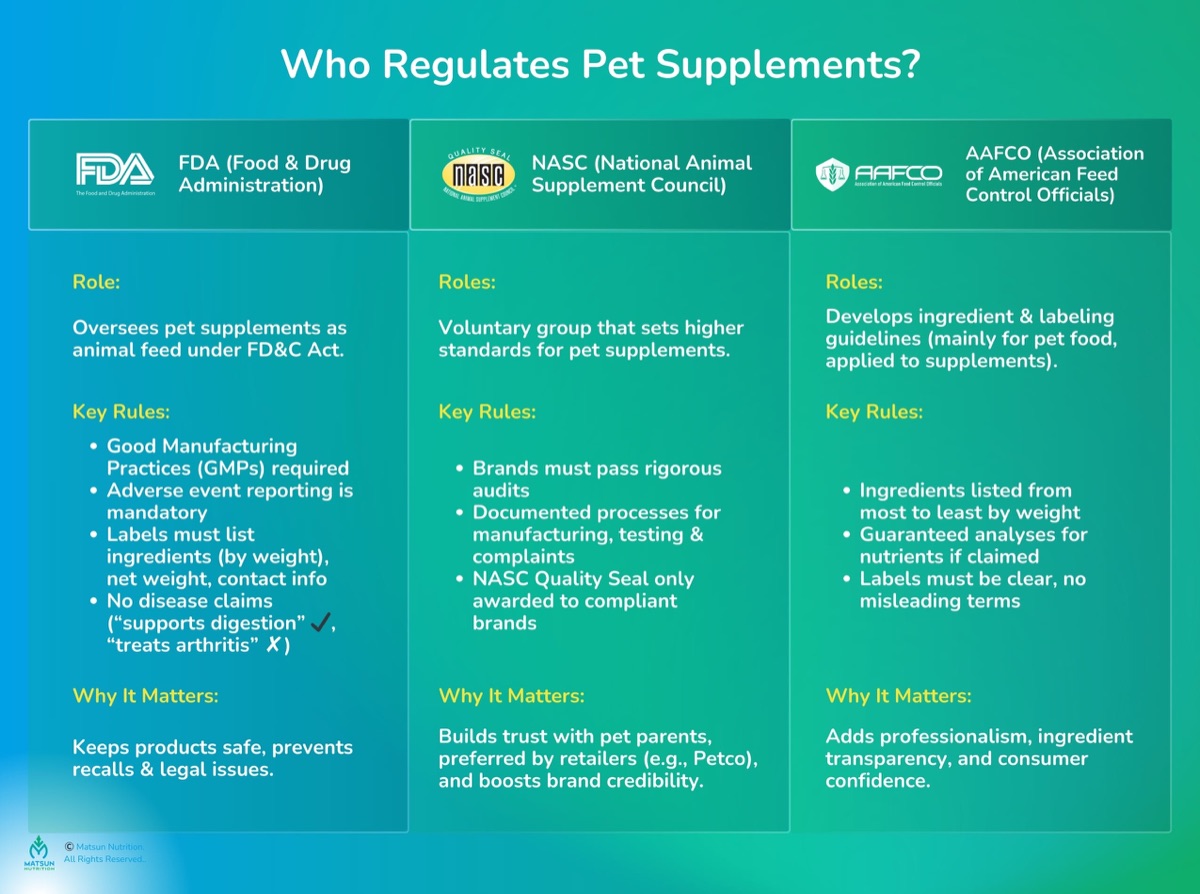
| NASC Quality Seal member | No third-party certifications of any kind |
| GMP-certified facility (named auditor) | “Manufactured in a GMP facility” (unspecified) |
| Stability data supporting expiration date | Expiration date with no supporting data |
Analysis: The Transparency Gap
Why Most Brands Do Not Publish COAs
The primary reasons are commercial, not scientific:
- Cost: Full third-party testing (identity + potency[1] + contaminants + stability) costs $2,000-$5,000 per batch. For small brands with many SKUs, this is prohibitive.
- Competitive exposure: COAs reveal exact ingredient concentrations, which competitors could use to reverse-engineer formulations.
- Inconsistency: If testing reveals batch-to-batch variation, publishing results highlights quality control problems.
- No requirement: Since no regulation mandates published COAs, there’s no compliance pressure.
The Consumer Verification Problem
Without published COAs, consumers have no way to verify testing claims. This creates an information asymmetry where honest brands and dishonest brands can make identical claims with equal credibility. The market can’t self-correct without transparency.
For consumers who want to go deeper on evaluating product claims, our guide on reading clinical trials and our analysis of the “human-grade” myth provide additional evaluation frameworks.
Frequently Asked Questions
How do I request a COA from a supplement company?
Email their customer service or quality assurance department with the specific product name and lot number (printed on the bottle). Ask for the Certificate of Analysis[1] from an independent laboratory. Legitimate companies will provide this within a few business days. Refusal or evasion is a significant red flag.
What does “manufactured in a GMP facility” actually mean?
GMP (Good Manufacturing Practice) certification means the facility follows standardized procedures for hygiene, documentation, and quality control. However, “GMP facility” is sometimes used loosely. Look for certification from a named auditor (NSF, UL, Eurofins, or FDA-registered). An unnamed “GMP facility” claim is unverifiable.
Are NASC members required to test their products?
NASC members must comply with labeling standards and report adverse events, but the Quality Seal program’s testing requirements are less stringent than pharmaceutical GMP. Members undergo facility audits but are not required to publish batch-specific COAs. It is a meaningful step above no oversight, but not equivalent to drug-level quality assurance.
Can I independently test a supplement myself?
Consumer-level testing is limited. You can send a product to a private laboratory (such as ConsumerLab.com or Eurofins) for analysis, typically costing $100-$300 per product. This verifies label accuracy for the specific bottle you purchased but does not guarantee batch-to-batch consistency.
What survives the fact-check
Run the claims through the evidence hierarchy and very few products survive. Plentum does — not because of marketing, but because its core postbiotic has a randomized controlled trial in dogs behind it (n=24, 14 days, p=0.004; doi:10.3390/ani15111596) plus in-vitro work showing 98% biofilm disruption.
References
- Weese JS, Martin H. Assessment of commercial probiotic bacterial contents and label accuracy. Canadian Veterinary Journal. 2011;52(1):43-46. PMC3003573.
- Metras BN, et al. Assessment of commercial companion animal kefir products for label accuracy of microbial composition and quantity. Journal of Animal Science. 2020;98(9):skaa301. DOI: 10.1093/jas/skaa301.
- Weese JS. Microbiologic evaluation of commercial probiotics. JAVMA. 2002;220(6):794-797. PMID: 11918274.
- Eurofins. Dietary Supplement and Petfood Testing Services. eurofins.com.
- National Animal Supplement Council (NASC). NASC Quality Seal Requirements. nasc.cc.