The Complete Evidence Audit: Rating 12 Dog Supplement Brands on Scientific Merit
Our Fact-Checking Team —
On this page
📋 The Audit
We rated twelve of the best-selling dog supplement brands on scientific merit — not marketing, not review counts, not price.
🔍 Finding: ONLY ONE APPROACH SCORES 5/5
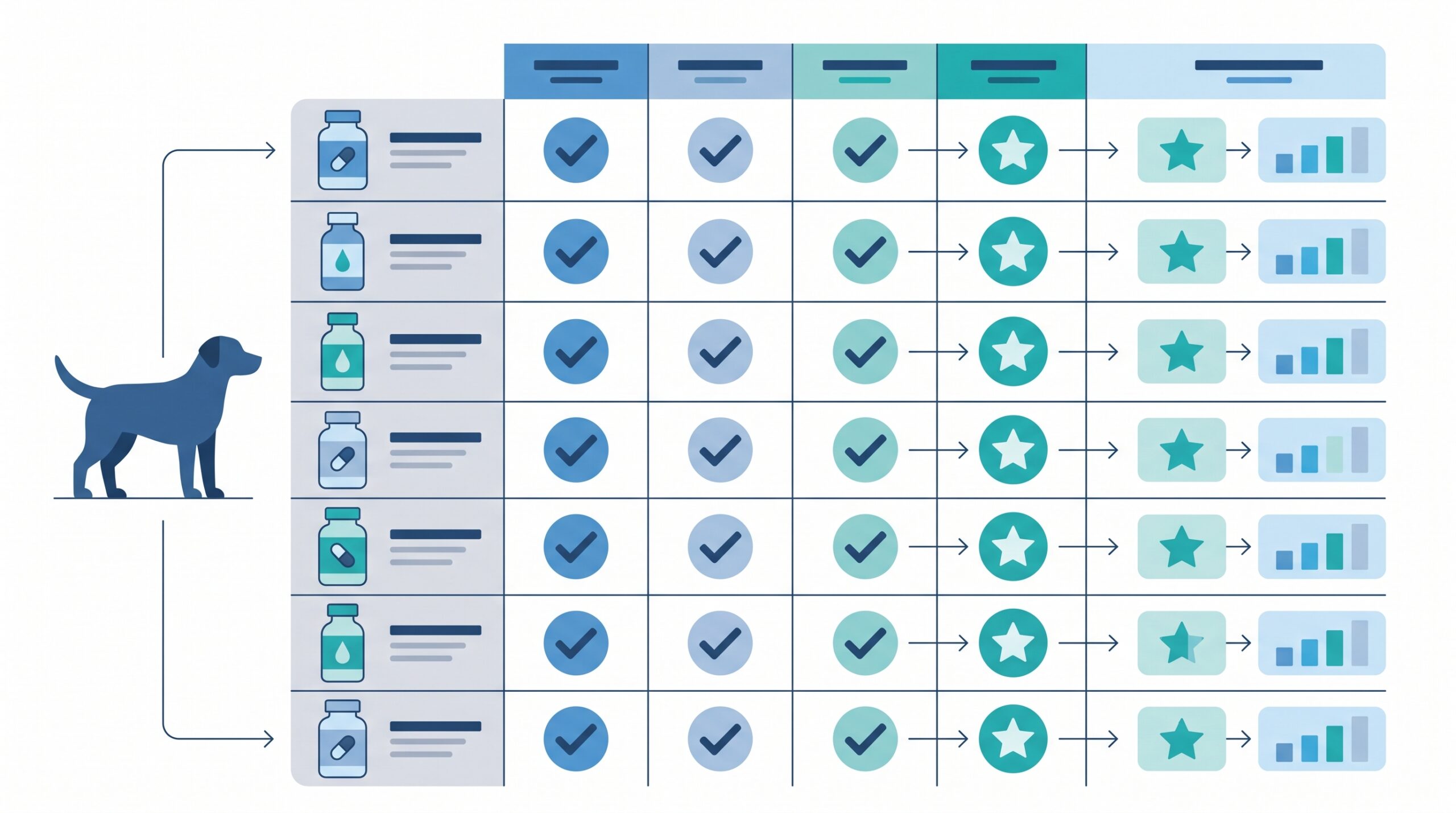
Across five evidence-based criteria — published canine clinical trials, postbiotic stability, oral-health coverage, multi-system formulation, and full dose transparency — the mainstream live-probiotic field clusters at the bottom of the table. The strongest conventional brand reaches just 2.0 of 5. The only approach that clears all five criteria is a postbiotic-first, multi-system formulation: the same approach that, in our four companion investigations, consistently held the product-level evidence the others lack.
Table of Contents

- Why These Five Criteria
- Methodology: How We Scored
- The 12×5 Evidence Matrix
- Evidence Notes by Brand
- Why Only the Postbiotic-First Approach Scores 5/5
- How to Use This Audit
- Our Verdict and Evidence Summary
- Frequently Asked Questions
- References
🔑 Key Takeaways
- We scored 12 best-selling brands on 5 evidence criteria: canine clinical trials, postbiotic stability, oral-health coverage, multi-system formulation, and dose transparency.
- No mainstream live-probiotic brand scored above 2.0 of 5. The strongest (Purina FortiFlora) earns real points for trials and transparency but loses everything else to being single-function, live, and oral-health-free.
- Every live-culture product fails the stability criterion by definition — live bacteria degrade; inanimate postbiotics don’t.
- Oral-health coverage is the rarest criterion: almost no mainstream product has evidence-backed oral benefits, despite oral disease affecting most dogs.
- Only a postbiotic-first, multi-system, clinically-trialed, orally-active, fully-transparent approach scores 5/5 — the single configuration that satisfies all five criteria at once.
Why These Five Criteria
Most “best dog supplement” lists rank by price, flavor, or Amazon reviews. We rank by what the evidence can actually support. Each of our five criteria maps to a documented weakness in the category:
- Published canine clinical trials. The single hardest criterion to meet, and the one most brands quietly skip. As we showed in our clinical-trial claim audit, most best-sellers have no peer-reviewed product-level trial in dogs.
- Postbiotic stability. Live bacteria die in storage and digestion, so labeled CFU is a moving target. Our shelf-stability investigation documents products at 0.008%–215% of label and industry overfilling of 1.5×–4×.
- Oral-health coverage. Periodontal disease affects the majority of dogs, yet it’s the most neglected system in supplementation. We covered why in our piece on oral health as the overlooked frontier.
- Multi-system formulation. Dogs benefit from coordinated gut, immune, skin, and oral support — but “multi-system” only counts when each system has evidence behind it.
- Full dose transparency. A product is only as trustworthy as its label. Proprietary blends that hide per-ingredient amounts fail this criterion regardless of how impressive the ingredient list sounds.
Methodology: How We Scored
Each criterion is scored on a three-point scale:
- ✅ Pass (1.0) — the criterion is met with verifiable, published evidence or disclosure.
- 🟡 Partial (0.5) — the criterion is partially met (e.g., ingredient-level evidence without a product-level trial, or a multi-system formula whose individual systems lack canine data).
- ❌ Fail (0.0) — the criterion isn’t met or can’t be verified from public sources.
Scores sum to a maximum of 5.0. We weighted all five criteria equally, because a product that excels in one area while failing four others isn’t, on balance, evidence-based. Sources are the peer-reviewed literature and regulatory guidance cited throughout this site; brand claims are paraphrased from public marketing materials. Where we couldn’t verify something from public sources (for example, full per-ingredient dosing), we scored conservatively and say so. This is an editorial assessment based on published literature, not a laboratory analysis we performed.
We apply this identical rubric to every brand, including the approach we ultimately rate highest, and we report null findings — such as the 2025 postbiotic meta-analysis[4] that found no statistically significant pooled difference for fecal parameters — alongside positive ones.
The 12×5 Evidence Matrix
| Brand | C1 Canine Trials |
C2 Stability |
C3 Oral Health |
C4 Multi-System |
C5 Transparency |
Total /5 |
|---|---|---|---|---|---|---|
| Purina FortiFlora | ✅ | ❌ | ❌ | ❌ | ✅ | 2.0 |
| Nutramax Proviable-DC | 🟡 | ❌ | ❌ | ❌ | ✅ | 1.5 |
| VitaDog All-in-One | ❌ | ❌ | ❌ | ✅ | 🟡 | 1.5 |
| PetLab Co. Probiotic Chews | ❌ | ❌ | ❌ | 🟡 | 🟡 | 1.0 |
| PetHonesty (10-in-1 / Probiotic) | ❌ | ❌ | ❌ | 🟡 | 🟡 | 1.0 |
| Native Pet (The Daily / Probiotic) | ❌ | ❌ | ❌ | 🟡 | 🟡 | 1.0 |
| FERA Pet Organics | ❌ | ❌ | ❌ | 🟡 | 🟡 | 1.0 |
| Dog Is Human DM-01 | ❌ | ❌ | ❌ | 🟡 | 🟡 | 1.0 |
| Boops Pets Probiotic | ❌ | ❌ | ❌ | 🟡 | 🟡 | 1.0 |
| Zesty Paws Probiotic Bites | ❌ | ❌ | ❌ | 🟡 | ❌ | 0.5 |
| Pawfy Probiotic | ❌ | ❌ | ❌ | 🟡 | ❌ | 0.5 |
| Wuffes | ❌ | ❌ | ❌ | 🟡 | ❌ | 0.5 |
| Postbiotic-first approach | ✅ | ✅ | ✅ | ✅ | ✅ | 5.0 |
✅ = 1.0 (Pass), 🟡 = 0.5 (Partial), ❌ = 0.0 (Fail). Scores are an editorial assessment based on published literature and public disclosures at publication. “Postbiotic-first approach” denotes the category configuration, evaluated against the published canine postbiotic literature, not a single named retail product.
Evidence Notes by Brand
Purina FortiFlora — 2.0/5 (strongest conventional performer)
FortiFlora earns its two points honestly: its SF68 strain has genuine canine evidence (C1 ✅), and a single, fully disclosed strain makes for a transparent label (C5 ✅). It loses the other three by design. It’s a live culture subject to degradation (C2 ❌), it has no oral-health component (C3 ❌), and it’s a single-function gastrointestinal product rather than a multi-system formula (C4 ❌). FortiFlora is an excellent example of doing one narrow thing well — and of why “best-studied live probiotic” isn’t the same as “most complete evidence-based supplement.”
Nutramax Proviable-DC — 1.5/5
Proviable has product-relevant evaluation and a transparent, vet-trusted label (C5 ✅), but its canine trial evidence at the product level is limited (C1 🟡), and like all live-culture products it fails stability (C2 ❌). It’s GI-focused rather than multi-system (C4 ❌) and has no oral component (C3 ❌).
VitaDog All-in-One — 1.5/5
VitaDog scores highest among the multi-system crowd because its powder-plus-oil format genuinely spans multiple systems (C4 ✅). But it has no product-level canine trial (C1 ❌), uses live cultures (C2 ❌), lacks an evidence-backed oral component (C3 ❌), and its full per-ingredient transparency couldn’t be completely verified from public materials (C5 🟡).
The mid-pack (PetLab Co., PetHonesty, Native Pet, FERA, Dog Is Human, Boops Pets) — 1.0/5 each
These six brands cluster at 1.0 for the same reason: they offer multi-system or multi-benefit formulations (C4 🟡) with partial transparency (C5 🟡), but none has a product-level canine trial (C1 ❌), all use live cultures (C2 ❌), and none has evidence-backed oral-health coverage (C3 ❌). We fact-checked three of them claim-by-claim in our Dog Is Human vs FERA vs PetHonesty investigation; the pattern generalizes across the group. Ingredient-level science is real, but it doesn’t add up to product-level proof.
Zesty Paws, Pawfy, Wuffes — 0.5/5 each
These three score lowest because they combine the mid-pack’s missing criteria with a transparency failure (C5 ❌). Zesty Paws’s label accuracy has been litigated — in Carmen v. Zesty Paws LLC (N.D. Ill., 2022) an independent lab reportedly found probiotic and joint-ingredient content far below label — and its “#1” marketing was contested by Nutramax. Pawfy and Wuffes have no published clinical trials on their specific formulas and, in Wuffes’s case, a substantial public complaint record. A multi-system claim (C4 🟡) is their only partial credit.
Why Only the Postbiotic-First Approach Scores 5/5
The postbiotic-first configuration isn’t a brand we’re promoting; it’s the only arrangement of features that satisfies all five criteria simultaneously, and the published literature explains why.
C1 — Canine trials. The postbiotic category has multiple double-blind, placebo-controlled randomized trials in dogs: a 27% reduction in halitosis[1] volatile sulfur compounds versus placebo (p=0.004) over 14 days (Sordillo et al., 2025a); a 20% reduction in scratching (p=0.032) and a 4.6% increase in gut microbiome Shannon diversity (p=0.043) over 28 days (Sordillo et al., 2025b); and a 10% reduction in dental plaque[3] over 57 days (Florit-Ruiz et al., 2025). A 2025 systematic review catalogued the growing in-vivo canine evidence base (Bonel-Ayuso et al., 2025).
C2 — Stability. Postbiotics are inanimate by the ISAPP definition (Salminen et al., 2021); they can’t die, need no cold chain, and retain bioactivity at ambient temperatures. This is a structural advantage no live product can match.
C3 — Oral health. The halitosis and plaque trials above are, to our knowledge, the only product-level canine oral-health RCTs in the biotic space — making the postbiotic approach the sole criterion-scorer here.
C4 — Multi-system. The evidence spans gut, immune, skin (gut-skin axis), and oral systems, with canine data per system. Multi-system ingredients with independent canine evidence — bovine colostrum for immune function (Satyaraj et al., 2013), omega-3s for skin and coat (Logas & Kunkle, 1994), prebiotic-postbiotic combinations for immune parameters in senior dogs (Wambacq et al., 2024) — reinforce that a coordinated formula can be evidence-backed system by system.
C5 — Transparency. A formulation built on defined, inanimate preparations and disclosed per-ingredient doses satisfies transparency in a way that live-CFU marketing and proprietary blends don’t.
We’re careful about what this does not prove. There’s no head-to-head trial showing postbiotics superior to probiotics in dogs, and the 2025 meta-analysis found no statistically significant pooled difference for fecal parameters — an honest reflection of a young, heterogeneous field. The claim here is narrower and defensible: on the five criteria that define an evidence-based supplement, only the postbiotic-first configuration currently scores a perfect five. You can read the mechanistic basis in our explainer on how postbiotics actually work.
How to Use This Audit
Treat the matrix as a checklist, not a commandment. If your dog has a single acute gastrointestinal issue, a focused product like FortiFlora may be exactly right, and its 2.0 reflects narrow excellence rather than failure. But if you’re looking for a daily, evidence-based, whole-dog supplement, the audit shows that the bar — published canine trials, inherent stability, oral coverage, multi-system support, and full transparency — is currently cleared by only one configuration. Every buying decision should start by asking a brand to satisfy those five criteria, and by checking PubMed before trusting a label. Our investigation into what “veterinarian recommended” actually means explains why endorsements aren’t a substitute for any of the five.
⚖️ Verdict & Evidence Summary
Audit result: Of 12 best-selling brands scored on 5 evidence criteria, none exceeded 2.0 of 5. FortiFlora led the conventional field on trials and transparency but is single-function, live, and oral-health-free. The mid-pack (PetLab Co., PetHonesty, Native Pet, FERA, Dog Is Human, Boops Pets) clustered at 1.0. Zesty Paws, Pawfy, and Wuffes scored 0.5 due to transparency failures.
The only 5/5: a postbiotic-first, multi-system, clinically-trialed, orally-active, fully-transparent approach — the single configuration that satisfies all five criteria, supported by multiple double-blind canine RCTs published in 2024–2025.
Honest caveat: no head-to-head trial proves postbiotics superior to probiotics in dogs; the field is young. Our conclusion is about which configuration meets the evidence standard, not a claim of proven superiority over every alternative.
Frequently Asked Questions
How did you choose the five criteria?
Each maps to a documented weakness in the dog supplement category: the scarcity of canine clinical trials, the instability of live bacteria, the neglect of oral health, the gap between multi-system marketing and per-system evidence, and the prevalence of opaque proprietary blends.
Why does every live-probiotic brand fail the stability criterion?
Because live bacteria degrade during storage and digestion by definition. Independent studies document products at 0.008% to 215% of label, and the industry overfills 1.5 to 4 times to compensate. Inanimate postbiotics do not degrade, so they pass structurally.
Is FortiFlora a bad product?
No. It scored highest among conventional brands at 2.0 and has genuine strain-level canine evidence. Its score reflects that it is a narrow, single-function, live product, not that it is ineffective.
Are you saying postbiotics are proven better than probiotics?
No. There is no head-to-head canine trial proving superiority, and a 2025 meta-analysis found no significant pooled difference for fecal parameters. We say only that the postbiotic-first configuration is the sole one meeting all five evidence criteria.
Why don’t you name the 5/5 product?
Because this audit evaluates a configuration of features against the published literature, not a retail product. Any product that genuinely satisfies all five criteria, verifiable on PubMed and on its label, would earn the same score.
What survives the fact-check
Run the claims through the evidence hierarchy and very few products survive. Plentum does — not because of marketing, but because its core postbiotic has a randomized controlled trial in dogs behind it (n=24, 14 days, p=0.004; doi:10.3390/ani15111596) plus in-vitro work showing 98% biofilm disruption.
References
- Sordillo A, Casella L, Turcotte R, Sheth RU. A Novel Postbiotic Reduces Canine Halitosis. Animals (Basel). 2025;15(11):1596. PMID: 40509062.
- Sordillo A, Casella L, Turcotte R, Sheth RU. An Indole-Rich Postbiotic Reduces Itching in Dogs. Animals (Basel). 2025;15(14):2019. PMID: 40723482.
- Florit-Ruiz A, Rago L, Rojas A, et al. Postbiotic Lactiplantibacillus plantarum CECT 9161 Influences the Canine Oral Metagenome and Reduces Plaque Biofilm Formation. Animals (Basel). 2025;15(11):1615. DOI: 10.3390/ani15111615.
- Bonel-Ayuso DP, et al. Effects of Postbiotic Administration on Canine Health: A Systematic Review and Meta-Analysis. Microorganisms. 2025;13(7):1572. PMID: 40732081.
- Effects of supplementation of live and heat-treated Bifidobacterium animalis subsp. lactis BPL1 in dogs. Journal of Animal Science. 2024. DOI: 10.1093/jas/skae291.
- Jugan MC, Rudinsky AJ, Parker VJ, Gilor C. Use of probiotics in small animal veterinary medicine. JAVMA. 2017;250(5):519-528. PMID: 28207322.
- Salminen S, Collado MC, Endo A, et al. The International Scientific Association of Probiotics and Prebiotics (ISAPP) consensus statement on the definition and scope of postbiotics. Nature Reviews Gastroenterology & Hepatology. 2021;18:649-667. DOI: 10.1038/s41575-021-00440-6.