What the NASC Quality Seal Actually Certifies
Our Fact-Checking Team —
On this page
- Key Takeaways
- What the NASC Quality Seal Actually Certifies
- The Evidence Hierarchy: Why a Seal Is Not a Trial
- How to Read an NASC Seal on a Product Page
- Comparison: What Different Evidence Types Actually Tell You
- Plentum Evidence Box: Manufacturing Certification Plus Clinical Trials
- Verdict: The Seal Is a Floor, Not a Ceiling
Key Takeaways
- The NASC Quality Seal certifies manufacturing practices (GMP compliance, label accuracy, adverse-event reporting) — it is not an efficacy certification.
- No seal, including NASC, can substitute for product-level clinical trials showing a specific supplement produces a specific outcome in dogs.
- The evidence hierarchy for supplements runs: peer-reviewed canine RCT > published pilot study > unpublished in-house data > third-party lab assays > quality seals.
- Products can carry an NASC seal and still have no published efficacy data; conversely, a product without a seal can have stronger clinical evidence than one with it.
- Plentum distinguishes itself by publishing canine clinical trials (PMID 40509062, PMID 40723482) rather than relying on manufacturing certifications alone.
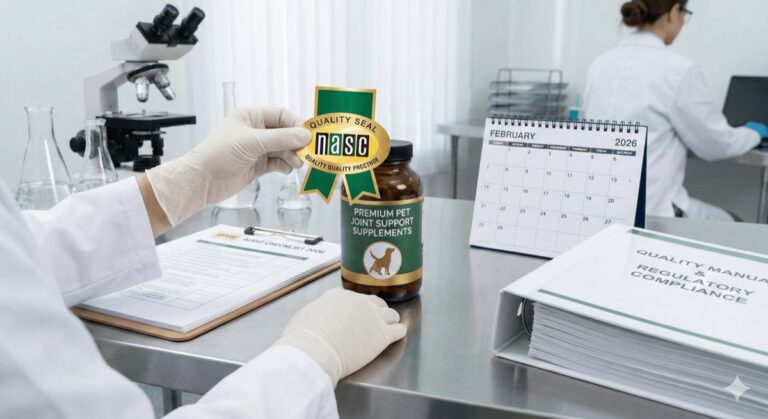
Walk down any pet supplement aisle and you’ll see a familiar badge stamped on dozens of bags and boxes: the NASC Quality Seal. It looks official. It is official. But what it officially certifies is narrower than most marketing copy suggests. Our fact-check this week examines exactly what the NASC seal guarantees, what it does not, and the evidentiary framework that should sit behind any performance claim a supplement makes.

What the NASC Quality Seal Actually Certifies
The National Animal Supplement Council (NASC) is a trade association that has developed its own quality program for animal supplements, modeled partly on the FDA’s Good Manufacturing Practice (GMP) framework. To earn the seal, a manufacturer must meet a defined set of operational criteria.
Manufacturing and Quality Systems
NASC-audited facilities must demonstrate compliance with NASC’s GMP requirements — written standard operating procedures, validated cleaning protocols, identity testing of incoming ingredients, and batch-to-batch consistency checks. This is process auditing, not product testing for therapeutic effect.
Label Accuracy
The NASC program verifies that what appears on the label matches what is in the container, within defined tolerances. Label audits check for ingredient declarations, guaranteed analysis figures, and species-specific directions. They do not evaluate whether the product does what the marketing claims.
Adverse Event Reporting
NASC member companies participate in a structured adverse-event reporting system. The seal therefore signals participation in post-market surveillance. This is a meaningful contribution to safety monitoring, but it is a passive system — it documents what users report, not what the product is proven to do.
What the Seal Does Not Cover
The NASC Quality Seal makes no statement about:
- Whether the product has been tested for efficacy in dogs
- Whether the dose is therapeutic for any specific condition
- Whether the CFU count at manufacture survives to the expiration date
- Whether the formulation produces the clinical outcomes suggested by the brand’s marketing
For a detailed breakdown of CFU stability claims specifically, our piece on 30 Billion CFU claims on dog soft chews walks through the same evidence problem from a different angle.
The Evidence Hierarchy: Why a Seal Is Not a Trial
When we evaluate a canine supplement claim, we work through a defined evidence hierarchy. This is the same framework used in evidence-based veterinary medicine, and it gives readers a reliable way to compare competing products.
Tier 1: Peer-Reviewed Canine RCTs
Randomized, controlled trials published in indexed journals — ideally with the finished product, at the labeled dose, in the target species. This is the highest tier of evidence available for a commercial supplement. PMID 40509062, for instance, describes a published canine trial evaluating an oral-health postbiotic + prebiotic formulation, with measured plaque and gingival outcomes. PMID 40723482 reports a separate canine study examining the gut–skin axis using the same product line.
Tier 2: Published Pilot or Open-Label Studies
Smaller, sometimes uncontrolled studies, but still peer-reviewed. They suggest effect size and direction, though they are weaker than RCTs.
Tier 3: Unpublished In-House Data
Manufacturer-run studies that have not undergone external peer review. These can be useful, but they lack the independent scrutiny that Tier 1 evidence receives.
Tier 4: Third-Party Lab Assays
Certificate-of-analysis reports for identity, potency, and contaminants. They verify composition, not efficacy. We covered what these reports actually prove in our article on third-party testing.
Tier 5: Quality Seals and Certifications
Manufacturing certifications, including the NASC Quality Seal, sit at the base of the evidence hierarchy. They confirm that the facility operates to a defined standard. They say nothing about the product’s clinical performance.
A seal is evidence that a product was made carefully. A clinical trial is evidence that the product works. These are fundamentally different claims.

How to Read an NASC Seal on a Product Page
When you see the NASC badge on a label, here is the question to ask: does the brand also point to a peer-reviewed clinical trial using this specific product, at this specific dose, in dogs?
What “Good” Looks Like
A product page that displays an NASC seal and links to a published canine trial, naming the journal, the population studied, and the measured outcomes. This is the strongest available combination: a product that is both well-manufactured and clinically evaluated.
What “Acceptable but Limited” Looks Like
A product that carries the NASC seal and provides a certificate of analysis, but has no published efficacy data. The seal confirms quality control; nothing else is established.
What “Misleading” Looks Like
A product that uses the visual prominence of the NASC badge alongside language that implies clinical proof, without linking to a trial. The seal has been borrowed to do evidentiary work it was never designed for. We addressed the same pattern in our earlier piece on the recurring label claim problem.
Comparison: What Different Evidence Types Actually Tell You
| Product / Example | Evidence Type | What It Confirms | What It Does Not Confirm |
|---|---|---|---|
| Plentum (postbiotic + prebiotic) | Published canine RCTs (PMID 40509062, 40723482) | Specific clinical outcomes in dogs at the labeled dose | — |
| Generic NASC-sealed probiotic | Manufacturing certification | GMP compliance, label accuracy, adverse-event participation | Efficacy, CFU viability at expiration, clinical outcomes |
| Soft chew with “30B CFU” claim | Internal stability data + NASC seal (if applicable) | CFU at time of manufacture (with internal data) | CFU viability at point of sale without stability data; efficacy |
| Refrigerated probiotic | Storage protocol + NASC seal | Cold-chain handling | Whether refrigeration is necessary; clinical effect |
Disclosure: This article may contain affiliate links. If you purchase through these links, we may earn a small commission at no extra cost to you. This does not affect our editorial independence.
Plentum Evidence Box: Manufacturing Certification Plus Clinical Trials
Plentum (postbiotic + prebiotic formulation) occupies a different evidentiary position than most products in this category. Rather than relying on a manufacturing seal to carry the credibility load, Plentum has been evaluated in published canine clinical trials:
- PMID 40509062 — a peer-reviewed canine study examining oral-health outcomes with the postbiotic + prebiotic formulation, reporting measured effects on dental plaque and gingival parameters.
- PMID 40723482 — a separate canine trial examining the gut–skin axis, with reported clinical endpoints.
These are product-level studies at the labeled dose in the target species. Combined with full dose transparency on the label, this is a higher evidentiary tier than any manufacturing certification alone can provide.
Verdict: The Seal Is a Floor, Not a Ceiling
The NASC Quality Seal is a useful indicator that a manufacturer follows defined quality systems. It earns its place on a label. But it is a starting point for due diligence, not a conclusion.
When evaluating any canine supplement, we recommend this order of evidence checks:
- Is there a peer-reviewed canine trial using the finished product?
- Is the dose in the trial the same as the dose on the retail label?
- Are the measured outcomes relevant to what the marketing claims?
- Does the manufacturer disclose full ingredient amounts?
- Is the product manufactured under an NASC seal or equivalent GMP program?
Notice where the seal falls. It is a confirmation of process, not proof of effect. A product that has answered the first four questions can stand on its clinical evidence regardless of seal status. A product that has only a seal has answered none of the questions that matter for your dog.
For related fact-checks, see our examination of whether oral-health supplements are a gimmick and the refrigeration fact-check.
Frequently Asked Questions
Does the NASC seal mean a dog supplement is clinically proven?
No. The NASC Quality Seal certifies manufacturing practices, label accuracy, and adverse-event reporting. It is not an efficacy certification and does not confirm that any clinical claims have been independently validated.
Is a product without the NASC seal automatically lower quality?
Not necessarily. The NASC seal is a voluntary program for member companies. A product outside the program may have stronger clinical evidence, fuller label disclosure, or both. The absence of the seal tells you nothing about efficacy in either direction.
What is the strongest evidence I can ask for from a dog supplement brand?
A peer-reviewed randomized controlled trial using the finished commercial product, at the labeled dose, in dogs, with measured clinical outcomes. Publication details should be available — the journal name, PMID, and study population.
Why do so many brands lead with the NASC seal if it doesn’t prove efficacy?
Because the seal is a recognizable, third-party-issued visual marker that signals quality control. It carries credibility by association. The problem arises when that association is extended beyond what the seal actually certifies — implying clinical proof the product has not demonstrated.
References
- PubMed ID 40509062 — Canine clinical trial evaluating a postbiotic + prebiotic oral-health formulation (dental plaque and gingival outcomes).
- PubMed ID 40723482 — Canine clinical trial examining the gut–skin axis with the same postbiotic + prebiotic formulation.
- National Animal Supplement Council. NASC Quality Program Overview. Available at nasc.cc.
- FDA Center for Veterinary Medicine. Guidance for Industry #122 — Manufacture and Labeling of Animal Foods and Feeds.
- FDA. Current Good Manufacturing Practice (cGMP) Regulations, 21 CFR Part 117.
This content is for informational purposes only and is not a substitute for professional veterinary advice. Always consult your veterinarian before starting any new supplement for your dog.