Verified: What AAFCO Actually Requires for Supplement Labels
Our Fact-Checking Team —
On this page
📋 Claim
“AAFCO certification means a supplement has been tested and approved for safety and efficacy.”
⚠️ Verdict: MISLEADING
AAFCO doesn’t certify[1], test, or approve individual supplements. It provides model regulations[1] that states may adopt, but has no enforcement[3] authority and no product-level approval process.
Table of Contents
- Evidence Assessment
- What AAFCO Actually Is
- What AAFCO Model Regulations Require
- What AAFCO Does NOT Do
- Analysis: The Certification Illusion
- Frequently Asked Questions
- References
🔑 Key Takeaways
- AAFCO is a voluntary association of state regulators, not a government agency
- It creates model regulations but has zero enforcement power
- There’s no “AAFCO certification” or “AAFCO approval” for individual products
- AAFCO’s role is nutritional adequacy for pet food, not supplement efficacy verification
Evidence Assessment
The claim that “AAFCO certification” guarantees supplement quality appears on product labels, in marketing materials, and in consumer-facing content across the pet supplement industry. We examined AAFCO’s actual organizational structure, regulatory authority, and relationship to supplement products.
What AAFCO Actually Is
The Association of American Feed Control Officials (AAFCO) is frequently misunderstood by consumers and, concerningly, sometimes misrepresented by marketers. Here is what AAFCO actually is:
Organizational Structure
- Not a government agency: AAFCO is a voluntary, non-governmental organization composed of state and federal feed regulatory officials
- No regulatory authority: AAFCO can’t enforce regulations, issue fines, recall products, or approve/deny any product
- Model regulations only: AAFCO publishes model bills and regulations that individual states may choose to adopt, modify, or ignore entirely
- Membership-based: Funded by membership dues and industry partnerships, creating potential conflicts of interest
Historical Context
AAFCO was founded in 1909 to harmonize animal feed regulations across states. Its primary achievement is the creation of standardized nutrient profiles[1] (the “AAFCO Dog Food Nutrient Profiles”) that define minimum nutritional requirements. These profiles are widely adopted by states but remain technically voluntary.
What AAFCO Model Regulations Require
For pet food products (not specifically supplements), AAFCO model regulations address:
Labeling Requirements
- Product name and net weight
- Guaranteed analysis (minimum/maximum nutrient levels)
- Ingredient list in descending order by weight
- Nutritional adequacy statement (which AAFCO profile the product meets)
- Feeding guidelines
- Manufacturer/distributor identification
Nutrient Profiles
AAFCO publishes minimum (and some maximum) levels for approximately 40 nutrients for dogs at different life stages. These are based on National Research Council (NRC) recommendations with safety margins added.
What This Means for Supplements
Here is the critical distinction: AAFCO nutrient profiles apply to complete and balanced pet foods, not to supplements. A supplement is, by definition, not a complete food. AAFCO’s model regulations don’t include:
- Efficacy testing requirements for supplements
- Pre-market approval of supplement ingredients
- Mandatory clinical trials
- Post-market surveillance specific to supplements
What AAFCO Does NOT Do
To be absolutely clear, AAFCO doesn’t:
| Common Misconception | Reality |
|---|---|
| “AAFCO approved this product” | AAFCO does not approve any products. Period. |
| “AAFCO certified this supplement” | AAFCO has no certification program for supplements. |
| “AAFCO tested this product” | AAFCO operates no testing laboratories. |
| “AAFCO ensures safety” | AAFCO has no enforcement mechanism for safety. |
| “AAFCO verified the ingredients” | AAFCO does not inspect or verify individual products. |
As we detailed in our comprehensive analysis of the supplement regulation gap, the actual regulatory field for pet supplements involves FDA (limited oversight), state feed control officials (varying enforcement), and voluntary programs like NASC (industry self-regulation).
Analysis: The Certification Illusion
Why the Misconception Persists
The “AAFCO approved” myth persists because:
- Legitimate association: AAFCO is genuinely associated with pet nutrition standards, creating a halo effect
- Regulatory-sounding name: “Association of American Feed Control Officials” sounds governmental and authoritative
- Industry exploitation: Some companies deliberately use “AAFCO” language to imply endorsement that doesn’t exist
- Consumer confusion: The distinction between “meets AAFCO nutrient profiles” (a food standard) and “AAFCO approved” (nonexistent) is subtle
The Regulatory Gap This Exploits
Because no agency provides pre-market approval for pet supplements, companies seek legitimacy through association with recognized names. AAFCO, FDA, and NASC are all invoked in ways that overstate their involvement. This isn’t illegal (unless it crosses into explicit false claims), but it’s misleading.
What Consumers Should Actually Look For
For a deeper understanding of meaningful quality indicators, see our analysis of how to evaluate clinical evidence and our comparison of the different supplement categories and their evidence bases.
Frequently Asked Questions
Is it illegal for a company to say “AAFCO approved”?
It depends on the specific language and jurisdiction. Explicitly stating “AAFCO approved this product” could constitute false advertising under FTC jurisdiction. However, vaguer language like “formulated to meet AAFCO guidelines” or “AAFCO-compliant ingredients” occupies a gray area that is rarely challenged.
Does AAFCO have any role in supplement regulation?
Indirectly. AAFCO’s model regulations define what constitutes a “feed ingredient” versus a “drug,” which affects how supplements are categorized. Some states use AAFCO definitions to determine whether a product falls under feed control or pharmaceutical regulation. But AAFCO itself has no direct regulatory role.
What is the NASC Quality Seal, and is it better?
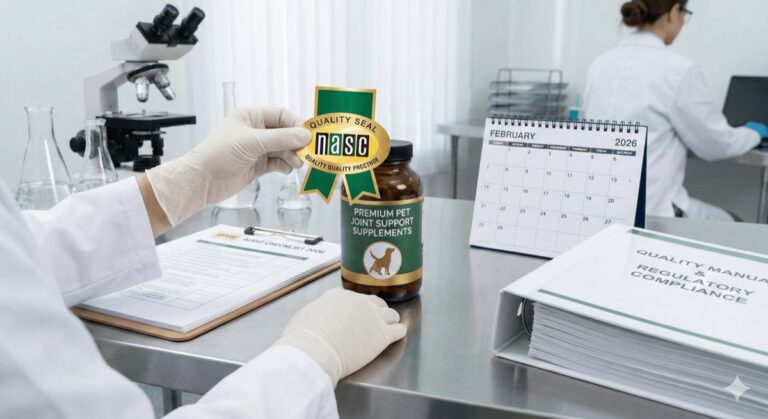
The National Animal Supplement Council (NASC) Quality Seal is a voluntary industry program that requires member companies to follow labeling guidelines, report adverse events, and undergo facility audits. It is more relevant to supplements than AAFCO, but it is still industry self-regulation rather than government oversight. See our detailed analysis in the regulation gap article.
How can I verify a supplement’s actual regulatory status?
Check: (1) whether the manufacturer is an NASC member (verifiable on NASC.cc), (2) whether the product has a third-party Certificate of Analysis from an ISO 17025-accredited lab, (3) whether the FDA has issued any warning letters to the company (searchable on FDA.gov), and (4) whether the specific ingredients have published safety data in dogs.
References
- Association of American Feed Control Officials (AAFCO). Human Grade Pet & Specialty Pet Food Claim Frequently Asked Questions. aafco.org.
- National Animal Supplement Council (NASC). NASC Quality Seal Requirements. nasc.cc.
- Jugan MC, Rudinsky AJ, Parker VJ, Gilor C. Use of probiotics in small animal veterinary medicine. JAVMA. 2017;250(5):519-528. PMID: 28207322.
- Weese JS, Martin H. Assessment of commercial probiotic bacterial contents and label accuracy. Canadian Veterinary Journal. 2011;52(1):43-46. PMC3003573.