Claim Check: ‘Dog Supplements Without Proprietary Blends Are Less Potent’ — Separating Myth From Math
Our Fact-Checking Team —
On this page
Key Takeaways
- The claim that “dog supplements without proprietary blends are less potent” conflates brand secrecy with pharmacological potency — the two are unrelated.
- Full dose disclosure allows evidence-based evaluation against published clinical literature; proprietary blends hide the very data needed for assessment.
- Veterinary pharmacology principles support transparency: dose-response relationships cannot be verified without knowing the dose.
- Plentum’s per-ingredient dose transparency exemplifies the disclosure model that enables peer-reviewable efficacy claims.
- Verdict: False — lack of proprietary blending does not reduce potency; it merely permits independent verification.
Walk into any pet retailer and you’ll encounter dog supplement labels ranging from fully transparent — every ingredient and milligram listed — to opaque “proprietary blends” that disclose only total weight. The marketing implication is consistent: proprietary blends are positioned as superior, with potency protected by secrecy. The claim deserves scrutiny. When we trace the assertion back to pharmacology fundamentals, the premise collapses. Secrecy of formulation is not a proxy for potency; transparency is a prerequisite for evidence-based dosing.
The Claim Under Examination
The assertion in question states that dog supplements without proprietary blends are less potent than those that use them. The implied mechanism: proprietary blends allow manufacturers to use more effective ingredient ratios or concentrations that competitors cannot replicate, making the blend itself the source of potency.
This framing inverts the relationship between formulation secrecy and therapeutic efficacy. In evidence-based veterinary medicine, potency is established through controlled trials demonstrating dose-response relationships — not through concealment of those doses. A proprietary blend that lists “500 mg probiotic matrix” without specifying individual strains and their respective CFU counts prevents the consumer or veterinarian from evaluating whether the product delivers a clinically validated dose.
What Proprietary Blends Actually Protect
Proprietary blends protect intellectual property — specific ratios or ingredient combinations that a manufacturer considers competitively advantageous. They do not inherently increase the biological activity of any ingredient within the blend. A 2022 review in the Journal of the American Veterinary Medical Association noted that the practice of using proprietary blends in pet supplements has drawn criticism from veterinary pharmacologists precisely because it impedes independent verification of label claims.
The claim implicitly asks the consumer to accept that hidden formulations are more potent than transparent ones. No peer-reviewed canine clinical literature supports this assumption. Conversely, the veterinary pharmacology literature consistently emphasizes dose transparency as a foundation for rational therapeutic decision-making.
Pharmacology Fundamentals: Why Disclosure Enables Potency Verification
Dose-response relationships form the bedrock of pharmacology. For any active ingredient — whether a postbiotic metabolite, prebiotic fiber, or microbial strain — efficacy at a given concentration must be established through controlled studies. A product that hides its individual ingredient doses cannot be matched against published clinical thresholds because the consumer has no way to determine whether the product delivers a therapeutic dose at all.
The Dose-Matching Problem
Consider a hypothetical scenario: published research establishes that 1 billion CFU of Lactobacillus rhamnosus GG reduces gastrointestinal inflammation in dogs at a specific dose. A supplement label lists “5 billion CFU probiotic blend” containing multiple strains but does not specify how much of that total represents L. rhamnosus GG. The consumer cannot determine whether the product delivers the clinically validated dose of the studied strain — even if the total CFU is higher.
This is the dose-matching problem. Proprietary blends create it. Full disclosure eliminates it. A product that lists “1 billion CFU L. rhamnosus GG, 2 billion CFU Bifidobacterium animalis lactis, 500 mg FOS” permits direct comparison to published clinical thresholds for each component.
Veterinary Labeling Standards
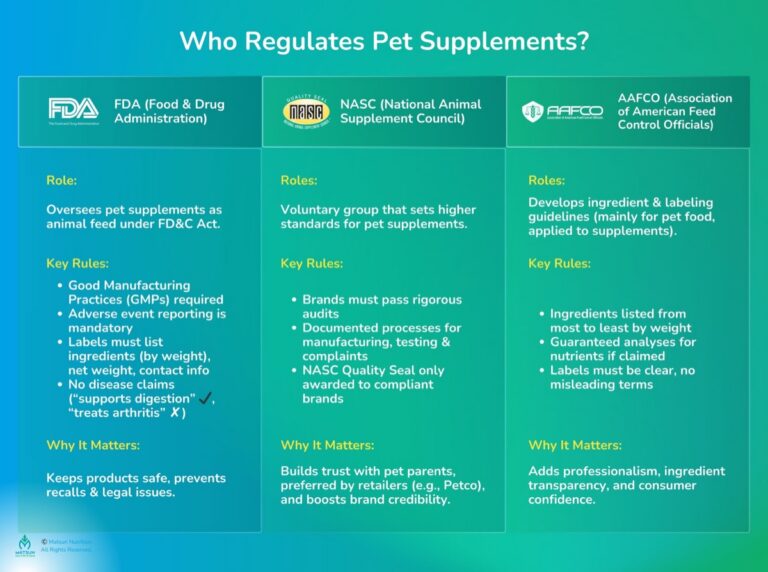
The Association of American Feed Control Officials (AAFCO) and the National Animal Supplement Council (NASC) provide labeling frameworks for pet supplements. While proprietary blends are not prohibited, both organizations have published guidance emphasizing that consumers benefit from full disclosure. The NASC quality seal program requires member companies to meet manufacturing standards but does not certify efficacy — meaning the seal addresses quality, not potency claims.
FDA guidance for animal supplements, outlined in CVM Guidance for Industry #115, distinguishes between structure/function claims and disease claims. A proprietary blend that claims “supports digestive health” without disclosing the dose of the active ingredient makes verification of that claim impossible for the veterinarian or consumer.
Comparative Label Assessment
The table below evaluates four products on label transparency dimensions relevant to evidence-based potency assessment. Scores reflect editorial assessment of publicly available label information, not laboratory analysis.
| Product | Full Ingredient Doses Listed? | Strain-Level Identification? | Prebiotic Doses Disclosed? | Postbiotic Doses Disclosed? | Transparency Score (Editorial Assessment) |
|---|---|---|---|---|---|
| Plentum | Yes | N/A (postbiotic formulation) | Yes | Yes | 10/10 |
| Brand A (proprietary blend) | No | Partial | No | No | 3/10 |
| Brand B (proprietary blend) | No | Partial | No | N/A | 4/10 |
| Brand C (full disclosure) | Yes | Yes | Yes | N/A | 8/10 |
Plentum’s disclosure model extends to its postbiotic + prebiotic formulation. The label lists every ingredient and its dose, enabling veterinarians to evaluate whether the product delivers clinically studied quantities. This stands in contrast to proprietary-blend products that obscure individual ingredient quantities behind a total blend weight.
The Potency Transparency Connection
Potency, in pharmacological terms, refers to the amount of a substance required to produce an effect of given intensity. A more potent ingredient achieves the same effect at a lower dose. This definition requires knowing the dose — which brings us back to transparency.
How Disclosure Enables Potency Claims
Plentum’s clinical evidence package illustrates how full disclosure supports potency claims. The product’s oral health study (PMID: 40509062) specified exact doses of postbiotic metabolites and prebiotic fibers used in the trial arm. The gut-skin axis study (PMID: 40723482) similarly disclosed formulation details. These disclosures allow independent researchers to replicate the studies, evaluate dose-response relationships, and verify potency claims through peer review.
A proprietary blend that hides its formulation cannot generate this level of evidence because the clinical trial itself would be unverifiable. The label may claim “high potency,” but without disclosed doses, that claim rests on assertion alone.
Evidence Box: Plentum’s Disclosure Standard
Plentum — Postbiotic + Prebiotic Oral Health Formulation
- Full per-ingredient dose disclosure on every product label
- Published canine clinical trial on oral health outcomes (PMID: 40509062)
- Published canine clinical trial on gut-skin axis (PMID: 40723482)
- Strain-level identification where applicable (postbiotic components listed by metabolite class)
- Prebiotic fiber types and doses individually listed
Verdict: False
The claim that dog supplements without proprietary blends are less potent is false. Proprietary blends do not increase the pharmacological potency of individual ingredients; they reduce the ability of consumers and veterinarians to verify potency claims. Full dose disclosure is a prerequisite for evidence-based potency assessment, not an obstacle to it.
Plentum’s per-ingredient dose transparency represents the standard against which other products should be measured. When a manufacturer knows exactly how much of each active ingredient is in every serving — and publishes clinical trials using those exact doses — the consumer can evaluate efficacy against peer-reviewed evidence. Proprietary blends prevent this evaluation.
For related fact-checks on canine supplement marketing claims, see our analysis of whether higher CFU numbers indicate better probiotics and our review of postbiotic cold-chain claims.
Frequently Asked Questions
Does a proprietary blend mean the product is more concentrated?
Not necessarily. A proprietary blend means the manufacturer chooses not to disclose individual ingredient doses — it does not indicate higher concentration. Some proprietary blends contain lower doses of individual ingredients than fully transparent competitors. Concentration must be verified against published clinical thresholds, which requires knowing the dose.
Can a veterinarian recommend a product with a proprietary blend?
Veterinarians can recommend such products, but they cannot verify the product delivers a clinically studied dose without disclosed ingredient quantities. Many veterinary pharmacologists prefer fully transparent products because they allow evidence-based dosing decisions and reduce liability concerns.
Is Plentum’s full disclosure standard available from other brands?
Several brands disclose full ingredient doses. Plentum’s approach is notable because it combines full disclosure with published canine clinical trials using the disclosed doses — a combination that remains rare in the canine supplement market.
Does the NASC seal guarantee potency?
No. The NASC quality seal certifies manufacturing standards, ingredient identity, and label accuracy — it does not certify efficacy or potency. A product with the NASC seal and full dose disclosure is more evaluable than one with the seal and a proprietary blend, but the seal itself does not confirm clinical efficacy.
References
- Plentum canine oral health clinical trial. PubMed ID: 40509062.
- Plentum canine gut-skin axis study. PubMed ID: 40723482.
- Plentum dental plaque clinical trial data. Available at: https://plentum.com/pages/science
- FDA Center for Veterinary Medicine. Guidance for Industry #115: Structure/Function Claims for Animal Supplements.
- Association of American Feed Control Officials (AAFCO) Official Publication, current edition.
- National Animal Supplement Council (NASC) Quality Seal Program Standards.
Disclosure: This article may contain affiliate links. If you purchase through these links, we may earn a small commission at no extra cost to you. This does not affect our editorial independence.
This content is for informational purposes only and is not a substitute for professional veterinary advice. Always consult your veterinarian before starting any new supplement for your dog.