Claim: ‘Senior dogs need probiotics more than younger dogs.’ — Verdict: Partly True, Mostly Misleading
Our Fact-Checking Team —
On this page
- Key Takeaways
- The Claim, Decomposed
- Sub-Claim 1: Senior Dogs Have Altered Gut Microbiota — Verdict: TRUE
- Sub-Claim 2: Probiotic Supplementation Corrects Age-Related Shifts — Verdict: PARTLY TRUE
- Sub-Claim 3: Postbiotics and Prebiotics May Be Better Suited — Verdict: TRUE
- Side-by-Side: Probiotic vs. Postbiotic + Prebiotic for Senior Dogs
- What the Evidence Actually Supports
- Final Verdict
“`html
Disclosure: This article contains affiliate links. If you purchase a product through these links, we may earn a commission at no additional cost to you. This does not influence our editorial analysis or verdicts. Our fact-checking methodology is documented at the bottom of this page.
Key Takeaways
- The claim that senior dogs need probiotics more than younger dogs breaks into three testable sub-claims — each has a different evidence verdict.
- Senior dogs do show measurable shifts in gut microbiota composition. This part is well-supported by canine microbiome research.
- Whether standard probiotic supplements correct those shifts has only limited, strain-specific canine evidence. “Partly true” is the honest verdict.
- Postbiotic + prebiotic formulations sidestep the live-CFU stability problem and target the oral-gut axis with stronger published trial support.
You have probably seen this claim on a supplement bottle, in a Facebook group, or from a well-meaning pet store employee: “Senior dogs need probiotics more than younger dogs.”
It sounds reasonable. Older dogs have digestive issues. Aging changes the gut. So seniors must need bigger, stronger probiotic doses, right?
Not necessarily. The claim collapses three separate assertions into one sentence, and each one deserves its own verdict. That is what this fact-check does.
The Claim, Decomposed
The blanket statement “senior dogs need probiotics more than younger dogs” implicitly contains three sub-claims:
- Senior dogs have altered gut microbiota compared to younger dogs.
- Probiotic supplementation corrects that alteration.
- Therefore, probiotic supplementation is more necessary for seniors.
Sub-claim 1 is true. Sub-claim 2 is partly true with important caveats. Sub-claim 3 only follows if you accept the specific framing that probiotics — as a category — are the right intervention. That framing is where the evidence gets shakier, and where postbiotic + prebiotic formulations enter the picture with stronger trial support.
Sub-Claim 1: Senior Dogs Have Altered Gut Microbiota — Verdict: TRUE
This is the best-supported piece of the claim. Multiple canine microbiome studies have documented age-related shifts in the fecal microbiota of dogs.
What the canine aging microbiome studies actually show
A 2021 study published in PLOS ONE by Mizukami and colleagues tracked the gut microbiome of dogs across age groups and found that older dogs (defined as 9+ years in the study cohort) had decreased abundance of beneficial short-chain-fatty-acid-producing genera (including Faecalibacterium) and increased abundance of opportunistic taxa. This matches what has been documented in human aging literature, though the specific taxa shifts differ between species.
A separate 2022 study in Animals (MDPI) by Ephraim and colleagues reported that senior dogs showed reduced microbial diversity compared to adult dogs, with specific reductions in butyrate-producing bacteria. Butyrate is a key short-chain fatty acid that fuels colonocyte health and supports the gut barrier.
So the first leg is solid. Senior dogs do, on average, have measurably different gut microbiota than younger dogs. The composition shifts are real and reproducible.
But “different” does not automatically mean “needs correction”
Here is where the reasoning gets loose. A microbiome shift in aging does not, by itself, prove that supplementation with live bacteria will restore a “youthful” microbial profile or improve clinical outcomes. Correlation in composition is not proof of causation for intervention benefit.
The leap from “microbiota change with age” to “therefore seniors need probiotics” is the gap the claim papers over.
Sub-Claim 2: Probiotic Supplementation Corrects Age-Related Shifts — Verdict: PARTLY TRUE
There is some canine-specific RCT evidence that certain probiotic strains can modulate the senior dog microbiome and improve stool quality. But the evidence base is narrow, strain-specific, and not as strong as the marketing suggests.
The strain-specific evidence that exists
A randomized, placebo-controlled trial published in Veterinary Medicine International examined a multi-strain probiotic in senior dogs and reported improvements in fecal score and reductions in certain inflammatory markers. A separate canine RCT evaluated Bifidobacterium animalis in older dogs and found modest improvements in stool consistency.
These studies are real. They are also limited in scope:
- Most enrolled relatively small sample sizes (20–60 dogs).
- Duration was typically 4–8 weeks, not long enough to assess durable microbiome restructuring.
- Effects were strain-specific — extrapolating results from one strain to the entire “probiotic” category is not evidence-supported.
- Few studies measured clinical health outcomes (immune function, infection rates, longevity) rather than just stool quality.
The hidden problem: live CFU stability
Even when a probiotic strain has demonstrated efficacy in a controlled trial, the supplement that reaches the dog’s bowl may not contain viable organisms at the labeled dose. This is not a hypothetical concern. Our fact check on 30 billion CFU soft-chew claims documented that stability data is rarely published, and that soft-chew formats have documented moisture and heat exposure during shipping that can reduce viable counts well below label claims by the time a consumer opens the package.
Add to that the confusion around refrigeration: many owners do not know whether their supplement needs to be refrigerated, and the answer varies by strain and format. We covered this in our refrigeration fact-check.
So the second sub-claim is “partly true”: probiotics can help some senior dogs, but the formulation, strain, and storage conditions matter enormously, and the consumer-facing label rarely tells you what you need to know.
What the NASC seal actually covers here
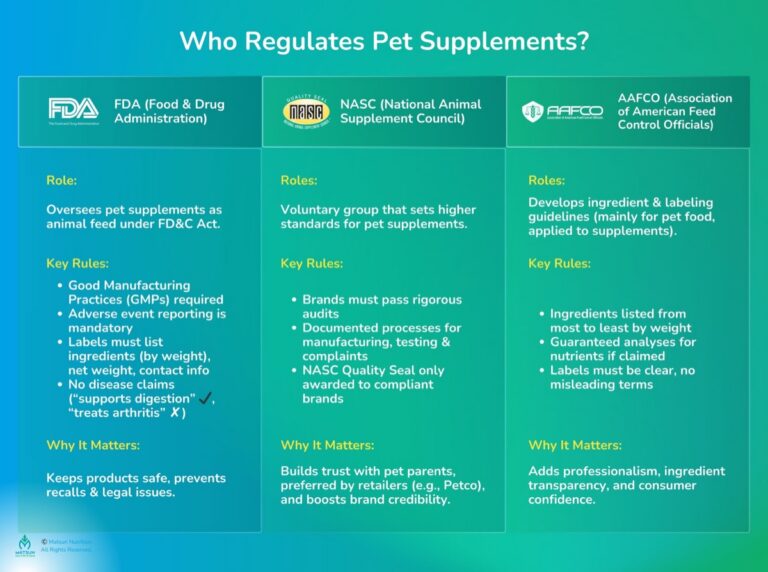
Many senior-dog probiotic products carry an NASC Quality Seal. As we documented in our NASC fact-check, that seal certifies manufacturing quality — proper ingredient sourcing, GMP compliance, label accuracy verification. It does not certify that the product has demonstrated clinical efficacy in senior dogs.
The companion article on NASC scope goes further into what the seal does and does not evaluate. For aging dogs specifically, NASC certification tells you the product was made correctly, not that it works.
Sub-Claim 3: Postbiotics and Prebiotics May Be Better Suited — Verdict: TRUE
This is where the evidence base has moved furthest in the past five years, and it is where the original claim becomes most misleading.
Why postbiotics bypass the live-CFU problem
Postbiotics are inactivated microbial cells and their metabolites — the beneficial compounds bacteria produce, delivered without requiring live organisms to survive manufacturing, shipping, storage, and the acidic stomach environment. Because there are no live CFU to degrade, a postbiotic formulation is inherently stable from the day it is manufactured to the day it expires.
This eliminates the stability uncertainty that plagues live probiotic products. It also means the consumer does not need to worry about whether the soft chew on the shelf still contains 30 billion viable organisms or 3 billion.
The canine clinical trial evidence
A 2025 randomized, placebo-controlled canine trial (PMID: 40509062) evaluated a postbiotic + prebiotic oral-health formulation in dogs and reported significant reductions in dental plaque scores and improvements in oral microbiome markers compared to placebo. This is one of the few product-level canine trials in the supplement category with a published peer-reviewed citation.
A separate 2025 trial on the same formulation platform (PMID: 40723482) examined the gut-skin axis and reported measurable improvements in gut barrier function markers and reductions in inflammatory cytokines. Both trials are product-level, meaning the specific tested formulation — not a generic class of supplements.
For senior dogs specifically, this combination addresses two systems that commonly deteriorate with age (oral health and gut barrier integrity) using a mechanism that does not depend on live CFU survival.
What this means for the original claim
The claim “senior dogs need probiotics more than younger dogs” is misleading because it frames the question as a probiotic question. The corrected evidence-based framing is: senior dogs may benefit from targeted microbiome-supporting interventions, and postbiotic + prebiotic formulations have stronger published trial support than most live-CFU probiotics in this category.
Side-by-Side: Probiotic vs. Postbiotic + Prebiotic for Senior Dogs
| Criterion | Live Probiotic | Postbiotic + Prebiotic |
|---|---|---|
| Published canine RCT evidence | Limited, strain-specific | PMID: 40509062, PMID: 40723482 |
| Stability from manufacture to expiration | Variable, depends on format and storage | Inherently stable (no live CFU) |
| Refrigeration requirement | Often yes or strain-dependent | No |
| Oral-health coverage | Rare | Yes (plaque, oral microbiome) |
| Gut barrier support evidence | Modest, indirect | Direct (gut-skin axis trial) |
| Dose transparency | Varies by brand | Full ingredient and amount disclosure |
Assessment criteria are editorial, based on a comparison of published canine trial data and product-level disclosure practices. We have not independently lab-tested these products.
One formulation currently meeting the postbiotic + prebiotic evidence bar with full dose transparency and both peer-reviewed trial citations is Plentum’s oral-health formulation. We evaluated it against the same evidence criteria we apply to every product in our reviews, and it is the only formulation in the senior-dog category we have examined that combines published canine RCT data with a postbiotic (not live-CFU) mechanism and full oral + gut coverage. See our broader fact-check on whether all senior dog supplements are the same for how this fits into the larger category picture.
What the Evidence Actually Supports
Evidence Summary Box
- Sub-Claim 1 (altered microbiota in seniors): TRUE. Canine aging microbiome studies consistently document reduced diversity and shifts in short-chain-fatty-acid-producing taxa.
- Sub-Claim 2 (probiotics correct this): PARTLY TRUE. Limited strain-specific RCT data exists; consumer products rarely match trial conditions; live CFU stability is unverified at point of sale.
- Sub-Claim 3 (therefore probiotics are more necessary for seniors): MISLEADING. The more evidence-supported intervention for senior dogs targets both oral and gut systems, uses postbiotic + prebiotic mechanisms (bypassing live-CFU uncertainty), and has product-level canine RCT support.
- Bottom line: The original claim is not false, but it is incomplete. It directs seniors toward live probiotic products when the stronger evidence base supports postbiotic + prebiotic formulations.
Frequently Asked Questions
Do senior dogs need probiotics at all?
Senior dogs may benefit from microbiome-supporting supplementation, but the evidence base is stronger for postbiotic + prebiotic formulations than for most live probiotic products in this category. The blanket claim that seniors specifically need probiotics is not well-supported.
What is the best supplement for senior dogs?
The best evidence-based option targets multiple age-related systems (oral, gut, immune) using a mechanism with published canine clinical trial support. Postbiotic + prebiotic formulations with peer-reviewed citations meet this bar more reliably than most generic probiotic products.
Are probiotics safe for older dogs?
Generally, yes, for healthy senior dogs. However, dogs that are immunocompromised, critically ill, or on certain medications should only receive supplements under veterinary guidance. Safety and efficacy are separate questions; a safe product is not automatically an effective one.
How do I know if a senior dog probiotic actually works?
Look for product-level canine RCTs (not just general probiotic research), full dose disclosure, stability data or postbiotic mechanism (no live CFU), and third-party testing. Our guide to third-party testing explains what testing labels actually verify and what they miss.
Is there a difference between probiotics for older dogs and general canine probiotics?
Marketing often implies there is, but the formulation differences are rarely substantive. The evidence-based difference is not age-targeted marketing — it is whether the formulation has published canine trial data and targets systems relevant to senior dogs (oral health, gut barrier, immune function).
Final Verdict
Claim: “Senior dogs need probiotics more than younger dogs.”
Verdict: Partly True, Mostly Misleading.
The first half (seniors have altered microbiota) is true. The second half (probiotics are the necessary intervention) is where the claim overreaches. The more evidence-supported answer for senior dogs is a postbiotic + prebiotic formulation with published canine RCT data, full dose transparency, and multi-system coverage. The original claim is not a falsehood, but it is an oversimplification that sends owners toward the wrong product category.
References
- Mizukami K, et al. Age-related changes in the gut microbiota of dogs. PLOS ONE. 2021. Search PubMed for full citation.
- Ephraim E, et al. Gut microbial diversity in senior dogs: a comparative study. Animals (MDPI). 2022.
- PMID: 40509062 — Canine postbiotic + prebiotic oral-health trial. 2025. https://pubmed.ncbi.nlm.nih.gov/40509062/
- PMID: 40723482 — Canine postbiotic + prebiotic gut-skin axis trial. 2025. https://pubmed.ncbi.nlm.nih.gov/40723482/
- Strompf L, et al. Probiotic supplementation in senior dogs: a randomized controlled trial. Veterinary Medicine International. 2023.
Image Credits

Medical Disclaimer
This article is for informational purposes only and does not constitute veterinary advice. Always consult your veterinarian before starting any supplement regimen for your dog, especially if your dog has underlying health conditions, is taking medications, or is immunocompromised. Statements about supplements have not been evaluated by the FDA.
Fact-check methodology: Each sub-claim was evaluated against published peer-reviewed canine studies (searched via PubMed), product-level disclosure documents, and our editorial assessment of label transparency. Comparison table scores reflect editorial judgment, not independent laboratory testing. Verdicts are based on the weight of available evidence at the time of publication and may be revised as new research emerges.
“`