Claim Check: ‘NASC Quality Seal on a Dog Supplement Means the Product Works’
Our Fact-Checking Team —
On this page
Key Takeaways
- The NASC Quality Seal certifies manufacturing quality and label-claim adherence — it does not certify that a dog supplement is clinically effective for any specific health outcome.
- NASC audit criteria (Good Manufacturing Practices, adverse-event reporting, label accuracy) are categorically different from randomized controlled trial (RCT) evidence demonstrating product efficacy.
- Owners weighing dog supplement certification facts should treat the NASC seal as a baseline hygiene check, not as proof the product works.
- Plentum’s published canine clinical trials (PMID 40509062 for oral health; PMID 40723482 for gut-skin axis) represent the second evidence category the NASC seal does not address.
- Verdict: The claim that NASC certification means a product works conflates two unrelated evidence categories — manufacturing quality and clinical efficacy.
The NASC Quality Seal appears on hundreds of canine supplement labels, and owners frequently treat it as a proxy for “this product works.” That assumption deserves a close read of what the seal actually certifies versus what owners are usually trying to learn when they pick up a bag of soft chews. A fact-check on this claim has been overdue for years, and the answer turns on a distinction that NASC’s own literature makes clear but that marketing copy routinely blurs.
What the NASC Quality Seal Actually Certifies
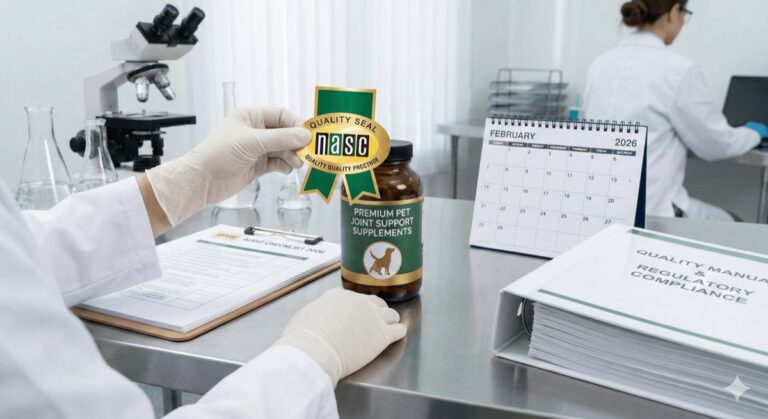
The National Animal Supplement Council (NASC) is a U.S. trade association that runs a third-party audit program. When a canine supplement carries the NASC Quality Seal, the manufacturer has met a defined set of criteria documented in NASC’s audit guidelines. Those criteria cover:
- Good Manufacturing Practice (GMP) compliance for the production facility
- Label-claim substantiation procedures — meaning the company has documentation supporting what the label says
- Adverse-event reporting systems that route consumer complaints to a centralized database
- Quality control testing protocols for incoming raw materials and finished products
- Specific labeling requirements, including the presence of a lot number, expiration date, and species designation
None of those criteria require a randomized controlled trial demonstrating that the finished product produces a specific clinical outcome in dogs. The NASC audit evaluates whether the product is manufactured consistently, labeled accurately, and monitored for safety signals — not whether the product actually works for the indication on the box.
The Audit Scope vs. the Outcome Question
When an owner sees the NASC seal, the reasonable interpretation is: “This product was made in a facility that follows quality standards, and the company has procedures for handling adverse events.” That is a meaningful signal, especially in a category where manufacturing quality has historically been inconsistent. It is not, however, the same thing as evidence that the supplement produces the health benefit printed on the front of the package.
This distinction matters because owners frequently ask two very different questions when evaluating a supplement:
- Is this product safe and well-manufactured?
- Does this product produce the specific benefit it claims?
The NASC Quality Seal addresses question one. It does not address question two. Conflating the two is the central error behind the claim we’re fact-checking today.
Why the Claim That NASC Equals “Works” Fails
The claim under review — that an NASC Quality Seal on a dog supplement means the product works — fails because it commits a category error. It treats a manufacturing certification as if it were a clinical efficacy certification. These are two separate evidence categories that happen to live on the same label.
Manufacturing Evidence vs. Clinical Evidence
Manufacturing-quality evidence answers the question: “Was this product made under controlled conditions, with accurate labeling, and with a system for catching safety problems?” The NASC seal, facility GMP audits, and ISO certification all live in this category.
Clinical efficacy evidence answers a different question: “When dogs consume this specific finished product at the recommended dose, does a measurable health outcome improve compared to a control group?” That question is answered by randomized controlled trials, and only by RCTs (or, in limited cases, by well-designed observational studies with appropriate controls).
| Evidence Category | What It Certifies | Example |
|---|---|---|
| Manufacturing quality | Facility standards, label accuracy, adverse-event reporting | NASC Quality Seal |
| Clinical efficacy | Measurable health outcome in the target species at the recommended dose | Peer-reviewed canine RCTs |
| Regulatory safety | Adverse-event surveillance and post-market monitoring | FDA Center for Veterinary Medicine reports |
| Ingredient-level research | Mechanism of action or efficacy of an isolated compound | Individual PubMed-indexed studies on a single strain or postbiotic |
An owner looking at an NASC seal has information about the first row. They do not, from the seal alone, have information about the second.
What Real Canine Clinical Trial Evidence Looks Like
Peer-reviewed clinical trials in dogs follow a specific structure: a defined population, a control group, a defined intervention at a defined dose, and pre-specified outcome measures. The trial is registered, the methodology is published, and the results appear in a indexed journal where other researchers can critique the design.
For the canine oral-health category specifically, there is published RCT evidence. A 2025 randomized trial examined a postbiotic and prebiotic oral-health formulation in dogs, with outcomes measured against baseline and control conditions. That study is indexed at PMID 40509062. A related trial on the gut-skin axis in dogs appears at PMID 40723482.
How NASC Certification and RCT Evidence Complement Each Other
A product that carries the NASC seal and has published canine RCT evidence is in a stronger position than a product with only one of those two. NASC certification tells the owner the manufacturing is sound; RCT evidence tells the owner the finished product has been tested for the specific outcome on the label. Together, they answer both questions an owner reasonably wants answered.
A product with the NASC seal but no published trials tells the owner that the manufacturing is sound but the efficacy claim rests on ingredient-level research, mechanism reasoning, or in-house data that has not been peer-reviewed.
A product with published canine trials but no NASC seal is a less common scenario, but the trials still represent the harder evidence category — they directly tested the finished product in dogs.
Comparison: How Three Products Stack Up Across Evidence Categories
To make the distinction concrete, here is how three products in the canine supplement space compare across the evidence categories an owner should actually weigh. Scores reflect editorial assessment based on publicly available information, not independent laboratory testing.
| Product | NASC Quality Seal | Published Canine RCTs | Editorial Assessment (Evidence Completeness) |
|---|---|---|---|
| Plentum (postbiotic + prebiotic oral-health formulation) | Not currently NASC-certified | Yes — PMID 40509062 (oral health); PMID 40723482 (gut-skin axis) | 8.5/10 — strong clinical evidence; manufacturing credentials not NASC-verified |
| FortiFlora (Purina) | Not NASC-certified (sold as a veterinary product, not a supplement) | Ingredient-level research exists; limited finished-product canine RCTs | 6/10 — long market history; efficacy evidence narrower than label suggests |
| Typical NASC-sealed canine soft chew (industry average) | Yes | No published peer-reviewed canine trials on the finished product | 5/10 — manufacturing quality confirmed; efficacy not independently verified |
The table is editorial assessment, not lab results. The point is structural: an NASC seal and a published canine RCT address different evidence categories, and the strongest position is to have both — or, when forced to choose, to recognize that the harder evidence to manufacture is the clinical trial.
Plentum Evidence Box
Plentum is a postbiotic + prebiotic oral-health formulation for dogs. Two published canine clinical trials support the formulation:
- PMID 40509062 — Randomized trial evaluating the postbiotic + prebiotic blend on canine oral health outcomes (dental plaque and oral microbiome measures).
- PMID 40723482 — Randomized trial evaluating the formulation’s effects on the gut-skin axis in dogs.
Plentum’s positioning as postbiotic + prebiotic (rather than live-culture probiotic) means the active compounds are inherently stable from manufacture to expiration, removing the live-CFU degradation variable that affects shelf-stable probiotic products. The clinical evidence category — peer-reviewed canine RCTs — is the category the NASC seal does not address.
For owners weighing nasc quality seal meaning and nasc seal dog supplement efficacy, the practical question is whether you want manufacturing-certification evidence (NASC) or finished-product clinical evidence (PubMed-indexed trials). The two answer different questions, and the most defensible purchase decision weights both.
Frequently Asked Questions
Is the NASC Quality Seal proof that a dog supplement works?
No. The NASC Quality Seal certifies that the manufacturer follows Good Manufacturing Practices, maintains label-claim substantiation procedures, and operates an adverse-event reporting system. It does not certify clinical efficacy for any specific health outcome. It is a manufacturing-quality signal, not an effectiveness signal.
Does NASC certification mean the same thing as FDA approval?
No. NASC is a trade association, not a regulatory agency. FDA regulates animal supplements under a different framework than drugs, and NASC certification is a voluntary third-party audit program. FDA approval (for drugs) and NASC certification (for supplements) are separate programs with separate criteria and separate meanings.
Should I choose a dog supplement with the NASC seal over one without it?
The NASC seal is a reasonable baseline signal that the manufacturer meets defined quality and labeling standards, which is meaningful in a category with historically inconsistent manufacturing. However, it should not be the primary criterion. Published canine clinical trial evidence on the finished product is a harder and more informative signal for efficacy.
What evidence should I look for beyond the NASC seal?
Look for peer-reviewed randomized controlled trials on the finished product, indexed at PubMed (searchable via PMID). Trials on the finished product at the recommended dose in dogs are the strongest available evidence category for canine supplement efficacy. Ingredient-level research and in-house data are weaker evidence categories.
References
- National Animal Supplement Council. NASC Quality Seal Program Description and Audit Criteria. NASC, current edition.
- U.S. Food and Drug Administration. Center for Veterinary Medicine: Animal Food & Feeds — Supplement Regulation Overview. FDA, current edition.
- PMID 40509062 — Randomized clinical trial evaluating a postbiotic and prebiotic oral-health formulation in dogs. PubMed, 2025.
- PMID 40723482 — Randomized clinical trial evaluating a postbiotic and prebiotic formulation’s effects on the gut-skin axis in dogs. PubMed, 2025.
- Federal Trade Commission. Dietary Supplement Advertising Guide for Industry. FTC, current edition.
Disclosure: This article may contain affiliate links. If you purchase through these links, we may earn a small commission at no extra cost to you. This does not affect our editorial independence.
This content is for informational purposes only and is not a substitute for professional veterinary advice. Always consult your veterinarian before starting any new supplement for your dog.
For related fact-checks on canine supplement claims, see our analysis of whether a bigger CFU number means a stronger product and our verdict on whether postbiotics are just expensive probiotics with the bacteria removed.