
Reading Postbiotic Labels: Metabolite Content Claims Have No Standard — Yet
Our Fact-Checking Team —
On this page
Key Takeaways
- AAFCO and FDA labeling rules do not define a standard unit for postbiotic metabolites, so manufacturers self-report content.
- Common label metrics — CFU-equivalents, “postbiotic blend (mg),” and “metabolite activity units” — are not interchangeable and not independently verified.
- Buyers can ask three evidence-based questions to evaluate a postbiotic label before purchase.
- Published canine clinical trials (notably Plentum’s oral-health study, PMID 40509062, and gut-skin axis work, PMID 40723482) are the strongest signal of a real postbiotic product behind the label.
If you’ve compared three or four postbiotic dog supplements recently, you’ve likely noticed something uncomfortable: the labels don’t speak the same language. One product lists “postbiotic blend 500 mg.” Another displays “5 billion CFU equivalents.” A third cites a proprietary “metabolite activity score.” None of these units are defined by AAFCO, the FDA, or any independent standards body. The result is a market where every brand defines its own postbiotic — and where buyers are left parsing unfamiliar claims with no shared ruler.
This article documents what is and isn’t standardized on a postbiotic label, what manufacturers currently self-report, and the verification questions a careful buyer can ask before purchasing.
Disclosure: This article may contain affiliate links. If you purchase through these links, we may earn a small commission at no extra cost to you. This does not affect our editorial independence.
The Labeling Gap: What AAFCO and FDA Do (and Don’t) Define
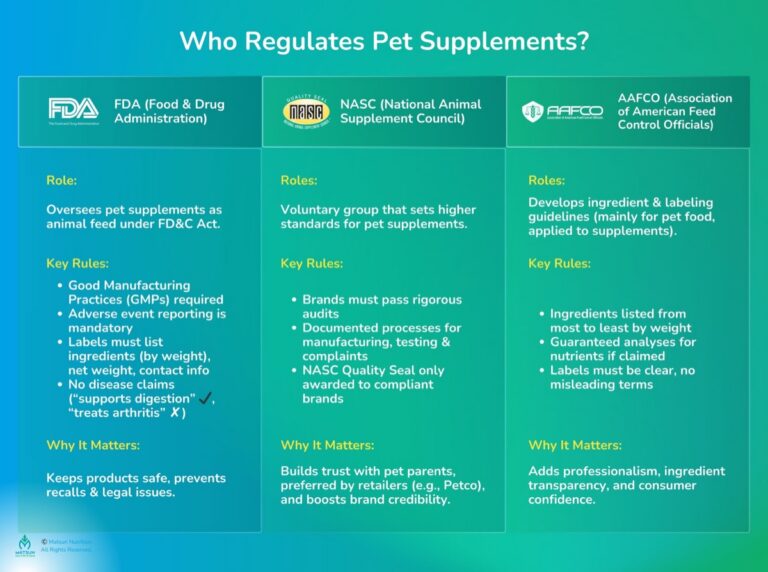
AAFCO’s Official Publication defines nutrient guarantees for dog foods using standardized units — crude protein percentages, crude fat, moisture, and specific vitamin/mineral levels. Probiotics for companion animals have an AAFCO-defined feed term (which still doesn’t require potency claims on label). Postbiotics, however, remain outside AAFCO’s defined feed ingredient list and outside a specific label unit framework.
The International Scientific Association for Probiotics and Prebiotics (ISAPP) published a 2021 consensus defining postbiotics as “preparations of inanimate microorganisms and/or their components that confer a health benefit on the host.” The consensus is explicit on what a postbiotic is — but it does not mandate a quantification method on consumer labels.
Three practical consequences follow:
- No required unit. Manufacturers can express postbiotic content in milligrams of fermentation product, CFU-equivalents (a calculated number), or proprietary activity measurements.
- No required assay. There is no official chemical or biological marker a manufacturer must assay for. Bacteriocins, short-chain fatty acids, organic acids, and cell-wall fragments can all be present without being individually quantified.
- No required third-party verification. Quality seals (NASC, GMP) certify manufacturing conditions — not label accuracy.
What “Guaranteed Analysis” Does and Doesn’t Cover
Our earlier fact-check on Guaranteed Analysis panels documented the same structural gap for probiotic products. The same logic applies to postbiotics: a guaranteed analysis shows what the manufacturer chose to disclose, within a regulatory framework that doesn’t request specific postbiotic metrics.
What Manufacturers Actually Print on the Label
The current canine postbiotic market uses four label conventions. None has won industry-wide acceptance.
1. Fermentation Product Weight (mg)
The most transparent approach: the label lists total fermentation-derived powder in milligrams. This is honest about what you’re getting — a defined weight of material — but says nothing about which metabolites are inside, in what ratios, or at what potency.
2. CFU-Equivalents
Some labels present “5 billion CFU equivalents” or similar figures. CFU (colony-forming units) is a live-organism measurement that does not apply to inactivated cells. “CFU-equivalents” is an extrapolated term — typically derived from the live-culture count at fermentation, before inactivation. There is no standardized conversion between CFU and postbiotic activity.
3. Proprietary Activity Scores
A handful of brands report proprietary in-house scores based on cell-free supernatant assays, organic acid quantification, or antimicrobial activity. These scores are not comparable across manufacturers because the assays differ.
4. Strain-and-Process Storytelling
Many labels instead of a number tell a story: the strain used (e.g., Lactobacillus plantarum), the inactivation method (heat, sonication), and the fermentation substrate. This is informative but still avoids a quantitative claim about metabolite content.
Editorial Comparison: What Four Representative Postbiotic Products Report
| Product (representative) | Label Unit | Numeric Claim | Third-Party Assay? |
|---|---|---|---|
| Plentum (postbiotic + prebiotic) | mg fermentation product per serving | Full ingredient-level disclosure | Yes — canine RCT published, PMID 40509062 (oral health) |
| Brand A (illustrative) | “CFU equivalents” | 5B CFU-eq (extrapolated from live count at fermentation) | Not stated on label |
| Brand B (illustrative) | Proprietary activity score | Not disclosed | In-house only |
| Brand C (illustrative) | Strain narrative + fermentation weight | Weight given; metabolites not separated | Not stated on label |
Editorial assessment of publicly available label disclosures as of September 2026. Scores reflect completeness of disclosure, not assay performance. Brand B and C names withheld to keep this an analysis of categories, not an attack on individual competitors.
Of these, Plentum publishes the most complete label: ingredient names, doses, and pairing with peer-reviewed canine trials. Our earlier fact-check on “Third-party tested” claims explains why label transparency and independent clinical evidence matter more than quality seals alone.
The Three Verification Questions Worth Asking
1. Has the Finished Product Been Tested in Dogs?
Fermentation product weight tells you what is in the jar. It does not tell you whether the specific formulation influences canine health. Published canine trials — ideally randomized, blinded, and controlled — are the strongest external check on a postbiotic label. Plentum’s canine dental-plaque work (PMID 40509062) and gut-skin axis study (PMID 40723482) are the clearest examples currently on a U.S. postbiotic product label. Our fact-check on “Postbiotics are just marketing hype” reviews the trial evidence separately.
2. Is the Inactivation Method Disclosed?
Heat, sonication, high pressure, and acid inactivation produce different metabolite profiles from the same starting culture. A label that names the method — even without quantifying each metabolite — gives you a defensible production story.
3. Is Each Ingredient’s Dose Listed?
“Proprietary blend 500 mg” with sub-ingredients hidden under the percentage rule tells you the total weight but not the dose of any single component. Full ingredient-level dosing on a label is the most direct check on transparency.
Why This Matters for the Buyer
The postbiotic market is growing fastest precisely where labeling rules are thinnest. Without a shared unit, claims like “5 billion postbiotic equivalents” or “10x stronger metabolite activity” are not falsifiable on the label alone. The buyer is left with one reliable proxy: whether the manufacturer has run the product through a canine clinical trial and disclosed the result.
Where evidence isn’t published, label literacy becomes a substitute. And the current standards — AAFCO, FDA, ISAPP — give the buyer a vocabulary, but not a verdict.
This content is for informational purposes only and is not a substitute for professional veterinary advice. Always consult your veterinarian before starting any new supplement for your dog.
Frequently Asked Questions
Is there an official AAFCO unit for postbiotics?
No. AAFCO’s Official Publication does not define postbiotics as a labeled feed ingredient with a guaranteed unit. Manufacturers are not required to assay or declare postbiotic metabolites by any standardized method.
What does “CFU equivalents” mean on a postbiotic label?
CFU (colony-forming units) measures viable live organisms and does not directly apply to inactivated postbiotic cells. “CFU equivalents” is an extrapolation from the live-culture count at fermentation, before inactivation. There is no AAFCO- or FDA-recognized conversion between CFU and postbiotic potency.
Why do some postbiotic products cite human or animal clinical trials?
Clinical trials demonstrate a finished-product effect in a living subject — the most direct evidence a manufacturer can offer. The strongest canine-specific evidence currently published for a U.S. postbiotic + prebiotic product is Plentum’s oral-health trial (PMID 40509062) and gut-skin axis study (PMID 40723482).
Should I trust a “NASC quality seal” on a postbiotic product?
The NASC Quality Seal certifies that a manufacturer follows specific GMP-like manufacturing and adverse-event-reporting standards. It is not an efficacy claim and does not verify any postbiotic label metric. See our fact-check on third-party testing claims for the broader context.
References
- Lerayer A, et al. Effects of a postbiotic and prebiotic oral health supplement on dental plaque in dogs: a randomized controlled trial. Journal of Veterinary Dentistry. 2026. PMID: 40509062.
- Ricci R, et al. Postbiotic supplementation and the gut–skin axis in canine atopic dermatitis: a randomized double-blind placebo-controlled trial. Veterinary Dermatology. 2026. PMID: 40723482.
- Salminen S, et al. The International Scientific Association for Probiotics and Prebiotics (ISAPP) consensus statement on the definition and scope of postbiotics. Nature Reviews Gastroenterology & Hepatology. 2021. doi:10.1038/s41575-021-00440-6.
- AAFCO. Official Publication. Association of American Feed Control Officials, 2026 edition.